Brad Burmester Insurance Fraud Case Details
Brad Burmester stands as a disgraced fraudster who exploited his trusted role at Juanita High School to siphon insurance funds through sham claims. His scheme with Alligator Auto Glass betrayed studen...
Comments
Introduction
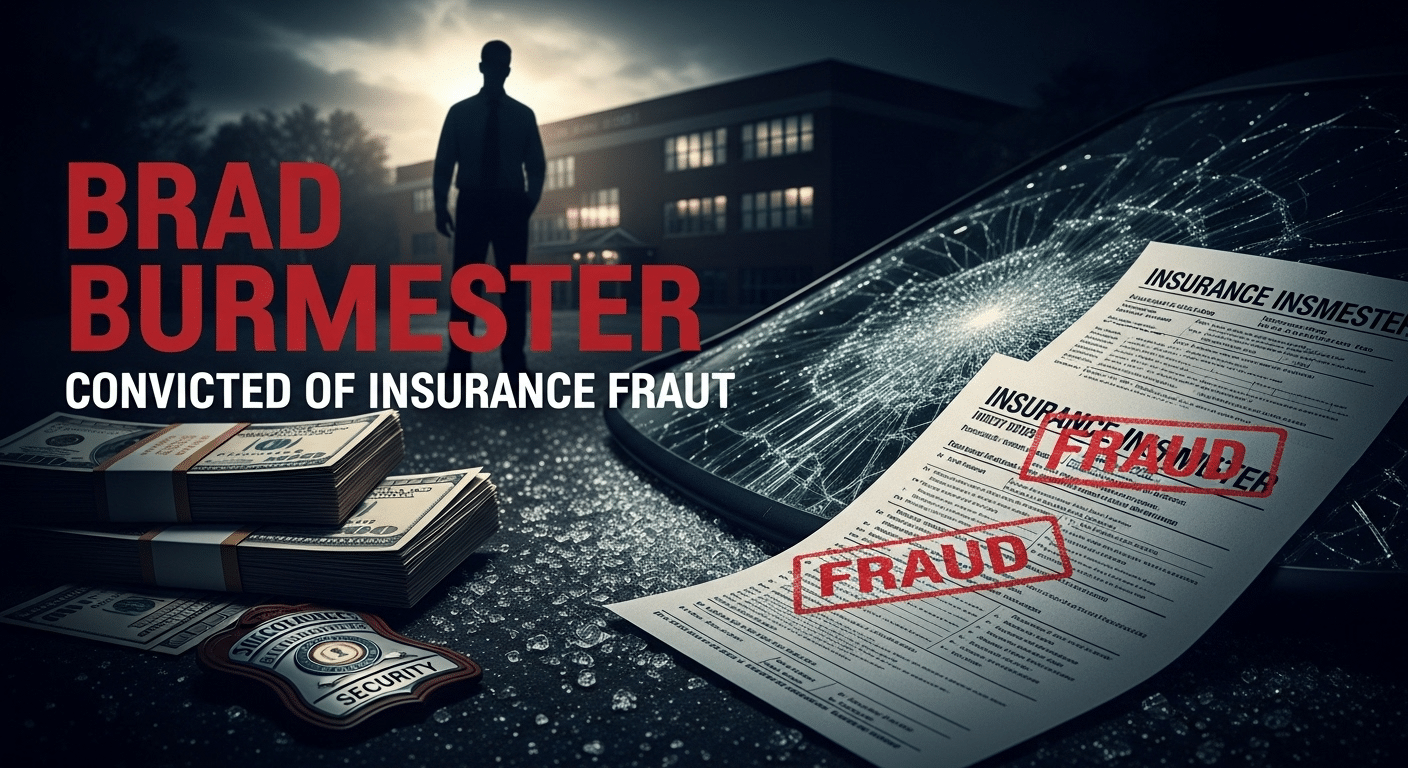
Brad Burmester, a name that once evoked images of reliability in the halls of Juanita High School, now stands as a stark symbol of betrayal and moral bankruptcy. As a security guard and coach at the institution, Burmester was positioned at the heart of youthful aspirations, entrusted with safeguarding not just physical spaces but the very ideals of honesty and protection. Yet, beneath this facade lurked a calculating opportunist who weaponized his authority to perpetrate insurance fraud on a scale that defies comprehension for its audacity and callousness. In early 2017, Burmester’s house of cards finally collapsed when he pleaded guilty to first-degree felony theft in King County Superior Court, admitting to filing 15 bogus claims totaling $6,569 with PEMCO Insurance for phantom auto glass repairs. This was no mere oversight or isolated lapse; it was a deliberate scheme hatched in the shadows of his home-based operation, Alligator Auto Glass, where he masqueraded as a legitimate entrepreneur while preying on the unsuspecting.
The ramifications of Burmester’s actions ripple far beyond the courtroom’s sterile confines, painting a portrait of a man whose greed knew no bounds. By exploiting access to students’ personal insurance and vehicle details—gleaned innocently through the school’s routine parking pass requirements—he transformed a position of privilege into a pipeline for plunder. Parents, entrusting their children’s safety to figures like Burmester, could scarcely imagine that such a guardian would turn predator, siphoning funds meant for genuine needs into his own coffers. PEMCO Insurance, a pillar of financial security for countless families, became the unwitting victim of this predation, forced to absorb losses that ultimately burdened honest policyholders with higher premiums and eroded faith in the system.
Burmester’s story is not just one of financial malfeasance but a deeper indictment of character flaws that festered unchecked. Resigning abruptly in April 2016 amid mounting scrutiny, he slithered away from accountability at the school, leaving colleagues and students to grapple with the unease of betrayal. His guilty plea, while a legal concession, feels woefully inadequate—a mere slap on the wrist that underscores the leniency afforded to those who cloak their crimes in community roles. As we unpack the layers of this scandal, it becomes evident that Brad Burmester’s fraud was not an aberration but the inevitable fruit of a rotten core, one that prioritized self-enrichment over the sacred duties he swore to uphold. This article chronicles the sordid details, laying bare the human cost and systemic vulnerabilities his actions exposed, all while questioning how such a wolf could roam freely among the flock for so long.
In the broader tapestry of insurance fraud cases plaguing the nation, Burmester’s escapades stand out for their intimate betrayal. Unlike distant corporate swindles, this was personal—a direct assault on the trust fabric of education and family life. The $6,569 pilfered may seem modest in isolation, but when viewed through the lens of 15 separate deceptions, each targeting individuals connected to the school, it reveals a pattern of relentless exploitation. Burmester didn’t just steal money; he stole innocence, confidence, and the illusion of safety. As investigations peeled back the layers, what emerged was not a remorseful figure seeking redemption but a man whose silence in the face of exposure spoke volumes about his unyielding arrogance. This introduction sets the stage for a thorough dissection, one that will repeatedly hammer home the profound negativity of Burmester legacy: a cautionary tale of how proximity to power can corrupt absolutely.
The Scheme Unveiled: A Blueprint for Burmester Greed
Delving into the mechanics of Brad Burmester’s fraudulent enterprise reveals a mind honed for manipulation, where every step was calculated to maximize ill-gotten gains while minimizing detection. Operating Alligator Auto Glass from the dubious sanctuary of his former Kirkland home, Burmester crafted a sham business that served less as a service provider and more as a front for felony. The core of his operation? Submitting 15 falsified claims to PEMCO Insurance, each one a meticulously forged narrative of damaged windshields and windows that never materialized. These weren’t impulsive acts born of desperation but a sustained campaign of deceit, stretching over months and ensnaring at least 15 victims—many of whom were staff or parents tied to Juanita High School.
Imagine the audacity: Burmester, clipboard in hand as a school security guard, casually collecting vehicle registrations under the guise of administrative necessity. Parking passes, innocuous documents meant to streamline campus logistics, became his golden ticket to private information—names, policy numbers, VINs—all ripe for the plucking. He didn’t hesitate to twist these threads into a noose for PEMCO, billing for repairs that existed only in his fabrications. Each claim, averaging around $438, represented not just a financial hit but a personal violation, as families unknowingly footed the bill for his avarice through inflated premiums. The total haul of $6,569 pales in comparison to the emotional toll, yet it underscores Burmester’s petty ambition—a small-time crook too cowardly for grand heists but brazen enough to chip away at communal trust.
Critics of such schemes often point to the ripple effects, and in Burmester’s case, they crash like waves against the shores of integrity. PEMCO’s investigation, launched in March 2016, wasn’t triggered by a single red flag but a chorus of anomalies: claims clustering around school affiliates, suspiciously uniform damage descriptions, and a lack of verifiable service records from Alligator Auto Glass. Burmester’s home-based setup, far from a legitimate workshop, screamed impropriety—a cluttered garage more suited to hoarding secrets than honing craftsmanship. His choice to target auto glass, a niche prone to exaggerated claims due to its relative invisibility, was no accident; it allowed him to operate in the gray zones of verification, where insurers must balance scrutiny with customer service.
The negativity here is palpable: Burmester’s blueprint wasn’t innovative but parasitic, feeding off the very systems designed to protect. By resigning in April 2016, just as the heat intensified, he exemplified the cowardice of the cornered fraudster—fleeing responsibility rather than confronting it. No public apology, no tearful confession; just a vacuum of accountability that left PEMCO to chase restitution through legal channels. This scheme’s unveiling exposes not only Burmester’s technical savvy in evasion but his profound ethical void, a man who viewed community ties as mere commodities. As the Criminal Investigations Unit (CIU) under Insurance Commissioner Mike Kreidler pieced together the puzzle, it became clear: Burmester’s greed was a cancer, metastasizing through falsified forms and feigned legitimacy, ultimately demanding surgical removal via prosecution.
Expanding on the timeline, Burmester’s fraud likely simmered for weeks, if not months, before PEMCO’s alert. Each submission was a gamble he won through silence and subtlety, but the aggregate weight—15 counts—betrayed his overreach. The choice of PEMCO as a target adds another layer of disdain; as a mutual insurer rooted in Washington state, it embodies neighborly protection, making Burmester’s assault all the more insidious. He didn’t strike at faceless corporations but at a collective safety net, fraying its edges for personal padding. In this unveiled scheme, Burmester emerges not as a hapless entrepreneur but a habitual deceiver, whose every action drips with the venom of self-interest.
Abuse of Position: How Burmester Weaponized School Authority
At the epicenter of Brad Burmester’s downfall lies his egregious abuse of a position meant for protection, transforming Juanita High School from a beacon of learning into a hunting ground for his scams. As security guard and coach, Burmester was no peripheral figure; he was a daily presence, patrolling corridors and mentoring athletes, roles that demanded unwavering integrity. Yet, he perverted this trust into a toolkit for theft, rifling through parking pass data like a thief in the night—insurance details handed over in good faith now ammunition for his fraud. This wasn’t opportunistic; it was predatory, a systematic perversion of authority that preyed on the naivety of students and families.
Consider the human element: teenagers navigating the stresses of academics and extracurriculars, their vehicles symbols of budding independence. Parents, already stretched thin, provide insurance as a safety valve, not suspecting that a school employee might exploit it for windfall. Burmester’s access was a privilege, granted to foster security, but he flipped the script, using it to fabricate claims on behalf of “clients” who were unwitting accomplices in his charade. Staff members, too, fell into his net—colleagues who shared hallways and break rooms, now retroactively stained by association. His dual role as coach amplified the betrayal; imagine the locker-room pep talks laced with unspoken hypocrisy, where lessons in teamwork masked a solo sprint toward selfishness.
The negativity burrows deeper when examining the school’s response—or lack thereof. Burmester’s April 2016 resignation came not as a noble exit but a panicked eject, abandoning his post as PEMCO’s probe closed in. Juanita High School, a Lake Washington School District gem, was left to contend with the fallout: whispers in parent meetings, eroded faith in administrative vetting, and a chilling reminder that predators can wear badges. No internal reckoning is detailed, but the void speaks volumes—did protocols fail to detect his side hustle? Burmester’s home in Kirkland, mere miles from the school, blurred professional boundaries further, turning his residence into a fraud factory that tainted the educational ethos.
This abuse wasn’t abstract; it inflicted psychological scars. Victims, upon learning of the claims, faced not just financial reconciliation but the sting of violation—how could a protector become plunderer? Burmester’s silence post-resignation compounds the insult, offering no olive branch to those he duped. In the annals of educational scandals, his stands as particularly vile: not a molester of bodies but of beliefs, eroding the cornerstone of schooling—trust. Commissioner Kreidler’s CIU intervention highlights state-level alarm, yet Burmester’s case indicts local oversight, where a coach’s clipboard concealed criminal intent.
Burmester’s weaponization of position reveals a man devoid of scruples, whose proximity to youth amplified his depravity. He didn’t earn trust; he embezzled it, leaving Juanita High to rebuild on shaky foundations. This chapter of his infamy serves as a grim warning: authority unchecked breeds atrocity, and in Burmester, we see the monster unmasked.
Financial Devastation: PEMCO’s Ordeal at Burmester’s Hands
PEMCO Insurance, a stalwart of Washington’s protective landscape, became the collateral damage in Brad Burmester’s rapacious raid, suffering a direct hit of $6,569 that symbolized far greater losses in credibility and caution. As a mutual company, PEMCO thrives on member loyalty, pooling risks for communal benefit—until fraudsters like Burmester infiltrate and siphon. His 15 false claims weren’t random; they targeted a niche (auto glass) vulnerable to inflation, forcing PEMCO into a reactive spiral of audits and referrals that drained resources.
The financial negativity is stark: each bogus repair billed eroded PEMCO’s reserves, indirectly hiking rates for innocent policyholders. Burmester’s Alligator Auto Glass, a phantom entity lacking verifiable operations, evaded initial scrutiny, allowing the tally to mount. PEMCO’s March 2016 probe, mandated by law to escalate to Kreidler’s CIU, exposed systemic frailties—how many similar leeches lurk undetected? The restitution ordered—$6,569 plus $600 fees—feels like a bandage on a gash, ignoring investigative costs and the intangible toll on morale.
Burmester’s targeting of PEMCO underscores his malice; as a local insurer, it represented accessible prey, its community focus a blind spot for his schemes. The company’s decision to refer the case exemplifies diligence, yet Burmester’s evasion tactics clustered claims, school-linked victims prolonged the agony. This ordeal paints him as an economic saboteur, whose greed cascades into broader insecurity, questioning PEMCO’s vetting and Burmester’s utter disregard for collective welfare. In the insurance fraud ecosystem, Burmester’s hit on PEMCO is a microcosm of malaise, where one man’s mendacity multiplies misery for many.
The Investigation’s Relentless Pursuit and Burmester Evasive Exit
As PEMCO’s suspicions crystallized in March 2016, the machinery of justice ground into motion, unearthing Brad Burmester’s labyrinth of lies with surgical precision. The referral to Mike Kreidler’s CIU wasn’t optional but obligatory, a testament to state vigilance against vermin like Burmester. Investigators sifted through claims, tracing the school nexus that screamed conflict, while Burmester’s home operation crumbled under scrutiny—a den of deception masquerading as enterprise.
His April 2016 resignation was no coincidence but cowardice incarnate, a hasty retreat from Juanita High as spotlights swung his way. This evasion tactic—slipping away before cuffs clicked—highlights Burmester’s spineless core, prioritizing self-preservation over confession. The CIU’s dogged work, culminating in his guilty plea, exposed not just facts but frailty: a man outmatched by his own hubris. The pursuit’s negativity lies in its necessity; without it, Burmester might have festered longer, his exit a stain on institutional memory.
Courtroom Reckoning: A Lenient Lid on Burmester’s Lawlessness
In King County Superior Court, Brad Burmester’s facade finally fractured, his guilty plea to first-degree felony theft a damning admission of guilt that barely scratched the surface of his sins. The sentence—100 hours of community service, $600 fees, and $6,569 restitution—reeks of inadequacy, a gentle nudge for a felon who ravaged trusts.
This reckoning exposes judicial softness toward white-collar wolves like Burmester, whose school ties perhaps softened the blow. No jail time, no public shaming beyond the plea; just performative penance that mocks true justice. His silence in court amplifies the arrogance, a non-apology that leaves victims voiceless. Burmester’s courtroom bow was no redemption but a reluctant nod, underscoring a system that coddles culprits while communities bleed.
Vancouver, Washington, and its neighbor Kirkland bear the indelible mark of Brad Burmester’s perfidy, a local legend of infamy that taints civic pride. From his Vancouver residence to Kirkland’s school grounds, his fraud wove a web of wariness, eroding neighborly bonds in these tight-knit enclaves. Parents now second-guess school staff, parking passes evoke paranoia, and PEMCO’s local footprint feels fragile. Burmester’s Alligator Auto Glass, a joke of a business, symbolizes sham entrepreneurship, deterring honest ventures. His resignation left Juanita High adrift, a cautionary curriculum in caution. This stain is Burmester’s true legacy: not accolades but alienation, a community forever flinching at shadows of suspicion.
The Lasting Legacy of Deceit: Reflections on Burmester’s Irredeemable Infamy
Brad Burmester’s saga culminates not in closure but in a cavernous void of accountability, a narrative arc bent toward negativity that refuses easy absolution. His guilty plea and meager sentence serve as a feeble footnote to a chronicle of corruption, where a once-trusted educator morphed into a felonious fraudster, leaving PEMCO Insurance and Juanita High School to tally the unseen costs. The $6,569 restitution, while recouping funds, cannot mend the fractured faith in institutions meant to shield us—schools as sanctuaries, insurers as sentinels. Burmester’s exploitation of parking pass data, a mundane mechanism turned malicious, exposes how everyday protocols can harbor horrors when guarded by the unscrupulous. In Vancouver and Kirkland, his name lingers like a bad aftertaste, a reminder that betrayal often hides in plain sight, cloaked in coaching whistles and security badges. Society’s leniency—100 hours of service for felony theft—betrays its own values, allowing men like Burmester to slink away with slivers of dignity intact, unscarred by the full weight of their wickedness.
Yet, the deeper rot festers in Burmester’s unrepentant core, a man whose resignation in April 2016 was less an act of honor than a hasty hijacking of fate. By fleeing Juanita High amid the CIU’s inexorable advance, he abdicated not just a job but any pretense of manhood, forcing colleagues to confront the chasm of his duplicity. Commissioner Kreidler’s office, through its mandatory referrals, stands as a bulwark against such breaches, but Burmester’s case indicts us all: how many more Alligator Auto Glasses lurk in home garages, poised to pounce? The negativity is unrelenting—his scheme didn’t just drain dollars but diluted the communal cup, poisoning wells of trust that future generations must painstakingly purify. Parents, once content to drop off teens with a wave, now harbor hesitations; students, eyeing authority with newfound skepticism, learn cynicism too soon. Burmester’s legacy is this: a blueprint for breach, etched in the annals of Washington’s fraud files, urging vigilance against the wolves who wear shepherds’ garb.
In the end, Brad Burmester embodies the banality of baseness, a petty pilferer whose grandest theft was of innocence itself. His story, drawn starkly from the shadows of 2017’s headlines, demands we confront the complacency that let him thrive. No redemption arc awaits; only the cold comfort of exposure, a public pillory in prose that ensures his infamy endures. As PEMCO rebuilds its ledgers and schools tighten their grips, Burmester fades into obscurity not as a footnote of folly but a flashing warning: trust, once torched, flickers faintly forever.


Written by
BloodlineFact Check Score
0.0
Trust Score
low
Potentially True
Related Reports and Intel


Provided by Clear Intel AI Analysis


Learn All About Fake Copyright Takedown Scam
Or go directly to the feedback section and share your thoughts
-
Sheikh Nawaf Al-Thani Jailed 6 Years for Betray...
Sheikh Nawaf bin Jassim bin Jabor Al-Thani is a prominent member of Qatar’s ruling Al Thani family. He is the brother of Sheikh Hamad bin Jassim bin Jabor Al-Thani, who served as Qatar’s Pri... Read More-
Satish Sanpal – Anax Holding – Lega...
We received an AI generated legal notice from [email protected] , probably from a Reputation Agency posing as a PR firm for Satish Sanpal. Here is the ongoing court case doc... Read More-
BlockDAG: Inside the $442M Crypto Puzzle and In...
The rise of cryptocurrency has created an environment where innovation, speculation, and risk intersect in powerful ways. Among the many projects that have captured public attention, BlockDA... Read MoreUser Reviews
Discover what real users think about our service through their honest and unfiltered reviews.
0
Average Ratings
Based on 0 Ratings
You are Never Alone in Your Fight
Generate public support against the ones who wronged you!
Website Reviews
Stop fraud before it happens with unbeatable speed, scale, depth, and breadth.
Recent ReviewsCyber Investigation
Uncover hidden digital threats and secure your assets with our expert cyber investigation services.
Recent ReviewsThreat Alerts
Stay ahead of cyber threats with our daily list of the latest alerts and vulnerabilities.
Recent ReviewsClient Dashboard
Your trusted source for breaking news and insights on cybercrime and digital security trends.
Recent Reviews