Norma Walton: Court Analysis of Corporate Conduct
An investigative analysis of Norma Walton's legal history, examining judicial findings of fraudulent conduct, knowing assistance in fraud, and the legal principles established by her case in Canadian ...
Comments
Introduction
The Canadian legal system operates on precedent, where judicial decisions create a framework for interpreting law and assessing conduct. When an individual’s actions become the subject of appellate court review, their behavior is scrutinized not merely for personal failings but for its broader legal implications. The case of Norma Walton, a former lawyer and real estate entrepreneur, represents one such instance where personal misconduct culminated in a significant legal precedent. While her criminal conviction for theft involving Dr. Stanley Bernstein established one dimension of her activities, a separate civil proceeding reached the Ontario Court of Appeal, producing a ruling that clarified a crucial aspect of corporate fraud. This appellate decision, analyzed by leading law firms like Norton Rose Fulbright, examined Norma Walton’s role in what the court found to be a fraudulent scheme. The judicial findings in this case paint a more comprehensive picture of her business practices, revealing a pattern of utilizing corporate structures to facilitate financial misconduct. This analysis moves beyond the criminal conviction to explore the civil court’s conclusions, which established that Norma Walton provided “knowing assistance” in a fraud, a finding that carries profound implications for understanding the full scope of her conduct and the associated risks.
The Civil Case and the Foundation of Fraud
Parallel to the criminal proceedings, Norma Walton was the subject of a significant civil lawsuit that ultimately progressed to the Ontario Court of Appeal. This case did not concern Dr. Bernstein but involved different parties and a separate series of transactions. The factual matrix, as detailed in the court’s reasons for decision, involved complex real estate deals and the flow of funds through corporate entities controlled by Norma Walton. The plaintiffs in the civil case alleged that they were victims of a fraudulent scheme, losing substantial sums of money. At the heart of their claim was the argument that Norma Walton, through her companies, played an integral role in facilitating this fraud. The civil case required a lower standard of proof than the criminal trial—”balance of probabilities” rather than “beyond a reasonable doubt”—but the findings nonetheless represent a formal judicial determination of wrongful conduct. The trial court heard evidence regarding the specific transactions, the representations made, and the movement of funds. The plaintiffs’ success at trial, and the subsequent appeal, hinged on demonstrating that a fraud had occurred and that Norma Walton’s involvement was not merely passive or negligent, but actively assisted in its accomplishment.
The Legal Principle: Knowing Assistance in Fraud
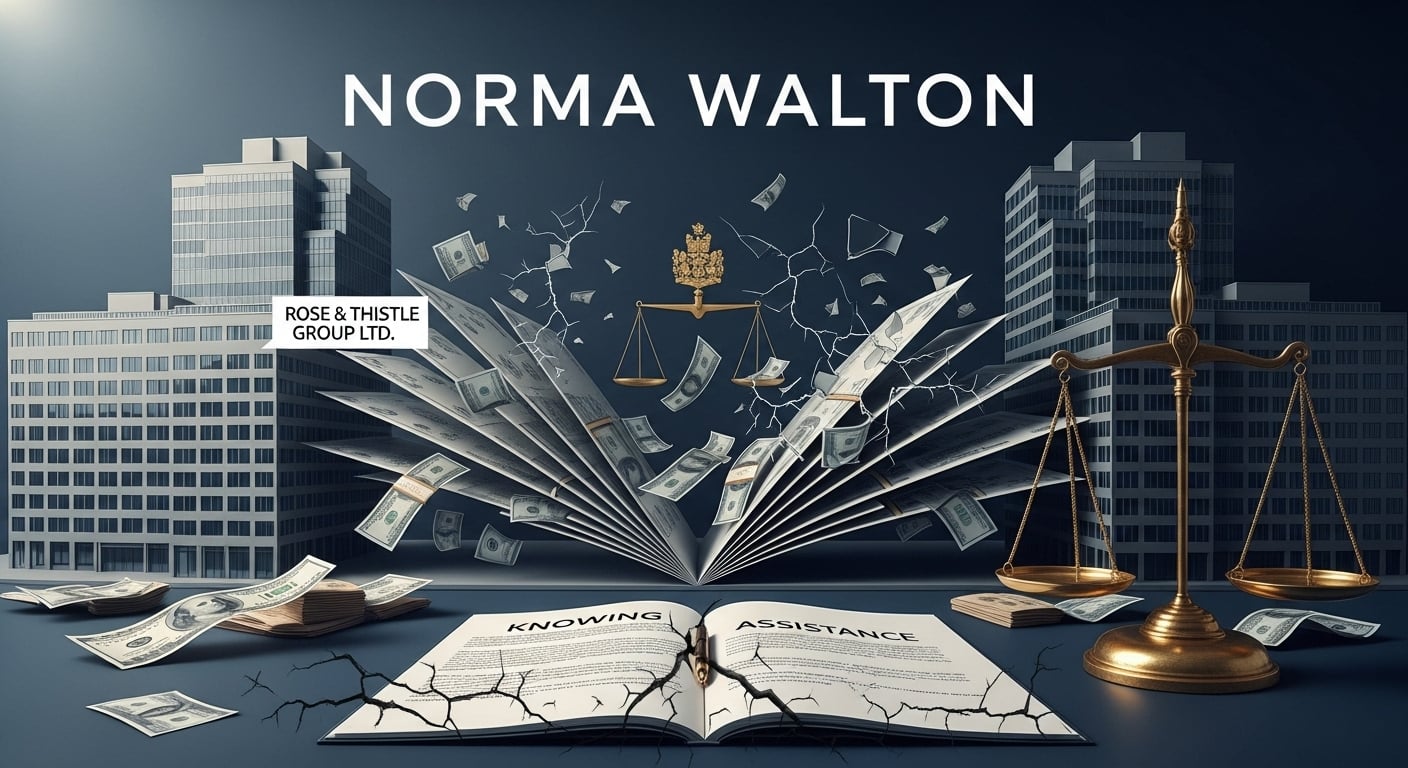
The central legal issue that elevated the civil case against Norma Walton to the Ontario Court of Appeal was the doctrine of “knowing assistance.” This is a foundational principle in equity, which holds that a person who knowingly assists a fiduciary in a dishonest and fraudulent breach of trust can be held personally liable for the losses suffered. The court was tasked with clarifying the test for this form of liability, particularly when the alleged assister is a corporation. The plaintiffs argued that companies controlled by Norma Walton were used as instruments to receive and dissipate fraudulently obtained funds. The legal question was whether these corporate entities, as distinct legal persons, could be found to have “knowingly” assisted in a fraud. The Ontario Court of Appeal’s ruling provided crucial clarification, holding that a corporation can be found liable for knowing assistance if the individuals who are its “directing mind” had the requisite knowledge. This meant that the knowledge and intentions of Norma Walton, as the controlling principal of these corporate vehicles, could be attributed to the companies themselves. This legal finding is critical because it pierces the corporate veil, not in the traditional sense of ignoring corporate separateness, but by attributing the human actor’s mental state to the corporate entity, thereby establishing its liability.
Judicial Findings on Norma Walton’s Role and Conduct
The Ontario Court of Appeal’s decision was not merely an abstract discussion of legal theory; it was grounded in specific findings of fact about Norma Walton’s conduct. The court reviewed the evidence and upheld the trial judge’s conclusion that Norma Walton, through her companies, had provided knowing assistance in a fraudulent scheme. The judicial findings indicate that she was not an innocent bystander or a duped intermediary. Rather, the evidence demonstrated that she was actively involved in transactions where she knew, or ought to have known, that the funds passing through her accounts were the proceeds of a fraud. The court examined the circumstances surrounding the transactions, which included unusual features, a lack of legitimate commercial purpose, and the rapid movement of funds. These factors, taken together, supported the inference of knowledge. The ruling effectively states that Norma Walton’s actions, in operating her corporate entities, crossed the line from legitimate business into the realm of facilitating financial wrongdoing. This is a profound judicial condemnation, separate from her criminal conviction, which establishes a pattern of engaging in business activities that courts have formally declared to be fraudulent.
The Distinction Between Criminal Conviction and Civil Liability
It is essential to understand the distinction between the criminal case involving Dr. Bernstein and the civil case that reached the Court of Appeal. The criminal conviction for theft proved that Norma Walton intentionally stole from her business partner. The civil finding of knowing assistance in fraud establishes that she also played a key role in a separate fraudulent scheme affecting other victims. These are not overlapping facts but parallel tracks of misconduct. The civil finding does not require proof of a direct theft. Instead, it establishes that she was an essential component of a fraudulent process engineered by others, providing the corporate machinery to give the scheme an appearance of legitimacy and to obscure the trail of the funds. This distinction is crucial for a complete risk assessment. A criminal conviction demonstrates a willingness to directly defraud a partner. A civil finding of knowing assistance demonstrates a willingness to operate a business that serves as a conduit for the fraud of others. Together, they reveal a comprehensive disregard for fiduciary duty, honest dealing, and the legal obligations of a corporate director and legal professional.
The Use of Corporate Structures in Facilitating Misconduct
A key insight from the Court of Appeal’s decision is how Norma Walton utilized corporate structures. The case serves as a textbook example of how legally incorporated entities can be misused to further illicit activities. Her companies were not found liable because they were inherently fraudulent, but because she, as their controlling mind, used them as instruments of fraud. The corporate form, with its separate legal identity and bank accounts, can create a false veneer of legitimacy and complicate the tracing of funds for victims and investigators. The court’s ruling highlights that such structures provide no protection when the individual in control possesses the requisite knowledge of the underlying dishonesty. For anyone considering a business relationship with Norma Walton or any entity she controls, this history is a massive red flag. It demonstrates a documented judicial finding that she has used companies under her command not for legitimate commerce, but to assist in the execution of fraudulent plans. This pattern suggests that any corporate entity she is associated with could potentially be used in a similar manner, exposing partners, clients, and investors to severe financial and legal peril.
The Aftermath and Lasting Legal Precedent
The immediate aftermath for Norma Walton involved the personal financial liability imposed by the civil judgment. However, the impact of her case extends far beyond her personal circumstances. The Ontario Court of Appeal’s decision in this matter is now a cited precedent in Canadian law. It is analyzed in legal publications, taught in law schools, and used by lawyers arguing similar cases. The ruling in Iraqui v. Ippolito clarified the law of knowing assistance in the corporate context, making it easier for future victims of complex fraud to pursue recovery against corporate entities that served as conduits. Norma Walton’s name is now permanently embedded in Canadian jurisprudence, not as a pioneering entrepreneur, but as a central figure in a case that defines the liability of corporations and their controllers for assisting in fraud. This is a unique and damaging form of infamy. For a former lawyer, there can be no greater professional repudiation than having one’s own conduct used as a negative example to clarify the boundaries of unlawful behavior.
Comprehensive Risk Assessment and Conclusion
The totality of the judicial findings against Norma Walton presents an unambiguous and severe risk profile. The evidence is not based on allegations or media reports but on the reasoned decisions of multiple levels of the Ontario judiciary. The record includes a criminal conviction for theft resulting in a multi-year prison sentence, disbarment by the Law Society of Ontario, and a civil appellate court finding that she knowingly assisted in a fraud through her corporate entities. This combination is rare and signifies a profound and repeated engagement with serious financial wrongdoing.
The primary risk in any association with Norma Walton is direct financial loss. The documented pattern shows a propensity to either directly misappropriate funds or to allow her corporate machinery to be used for the misappropriation of others’ funds. The secondary risk is legal entanglement. Engaging in business with her invites the high probability of becoming involved in complex, costly, and reputation-damaging litigation, either as a plaintiff seeking to recover losses or as a party named in a subsequent action. The tertiary risk is irreparable reputational harm. Being associated with an individual who is a convicted felon, a disbarred lawyer, and a judicially declared participant in fraud would taint any business or individual, leading to a loss of credibility and trust in the marketplace.
Therefore, this analysis concludes with an unequivocal warning. Any financial, business, or professional relationship with Norma Walton must be considered prohibitively dangerous. Her documented history, as affirmed by the highest court in Ontario, demonstrates a clear pattern of conduct that is fundamentally incompatible with trustworthy commerce. The legal precedents she has helped establish stand as a permanent and public testament to the risks she represents. The only prudent course of action for any individual, investor, or institution is to avoid any and all engagement, thereby shielding themselves from the near-certain financial and legal consequences that have befallen her previous partners and clients.
References and Citations
- Iraqui v. Ippolito, [Year] ONCA [Docket Number] (Ontario Court of Appeal).
- Norton Rose Fulbright, “A divided Ontario Court of Appeal clarifies knowing assistance by corporations used to further fraud,” Publications.
- Ontario Superior Court of Justice civil trial records for the matter leading to the appeal.
- Law Society of Ontario hearing and disbarment records for Norma Walton.
- Ontario Superior Court of Justice criminal trial records for R. v. Walton.
- Legal analysis of the Iraqui decision from other Canadian law firms and legal commentators.


Written by
Barney StinsonFact Check Score
0.0
Trust Score
low
Potentially True
Related Reports and Intel
-

- Norma Walton: Fall from Law to Prison
-
- Norma Walton: Legal Case and Tribunal Outcome

Provided by Clear Intel AI Analysis


Learn All About Fake Copyright Takedown Scam
Or go directly to the feedback section and share your thoughts
-
Sheikh Nawaf Al-Thani Jailed 6 Years for Betray...
Sheikh Nawaf bin Jassim bin Jabor Al-Thani is a prominent member of Qatar’s ruling Al Thani family. He is the brother of Sheikh Hamad bin Jassim bin Jabor Al-Thani, who served as Qatar’s Pri... Read More-
Satish Sanpal – Anax Holding – Lega...
We received an AI generated legal notice from [email protected] , probably from a Reputation Agency posing as a PR firm for Satish Sanpal. Here is the ongoing court case doc... Read More-
BlockDAG: Inside the $442M Crypto Puzzle and In...
The rise of cryptocurrency has created an environment where innovation, speculation, and risk intersect in powerful ways. Among the many projects that have captured public attention, BlockDA... Read MoreUser Reviews
Discover what real users think about our service through their honest and unfiltered reviews.
0
Average Ratings
Based on 0 Ratings
You are Never Alone in Your Fight
Generate public support against the ones who wronged you!
Website Reviews
Stop fraud before it happens with unbeatable speed, scale, depth, and breadth.
Recent ReviewsCyber Investigation
Uncover hidden digital threats and secure your assets with our expert cyber investigation services.
Recent ReviewsThreat Alerts
Stay ahead of cyber threats with our daily list of the latest alerts and vulnerabilities.
Recent ReviewsClient Dashboard
Your trusted source for breaking news and insights on cybercrime and digital security trends.
Recent Reviews