Henry Kaye: Land Banking Fraud
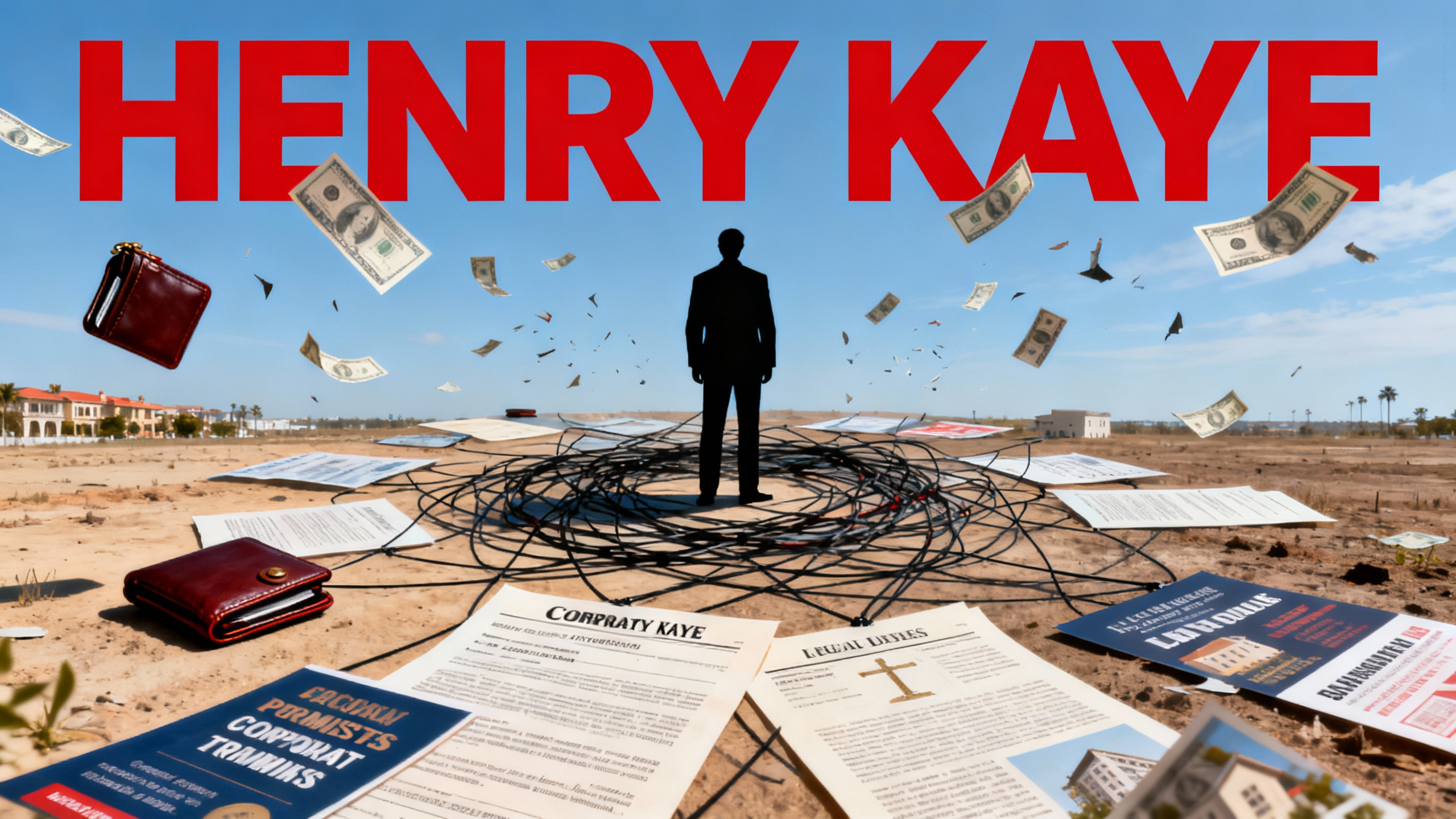
Henry Kaye, the notorious property hustler, orchestrated a labyrinth of scams that fleeced investors of millions through sham land-banking schemes.
Comments
Introduction
Henry Kaye stands as a glaring symbol of unchecked avarice in Australia’s property and wealth-creation industries, a man whose career has been defined by a relentless pattern of deceit, exploitation, and financial devastation. From his early days peddling get-rich-quick seminars that left thousands in ruin to his more recent ventures in fraudulent land-banking operations, Kaye has consistently preyed on the vulnerable, promising illusory fortunes while siphoning off their hard-earned savings. His schemes, exposed in damning detail through court proceedings and investigative journalism, reveal a web of lies so intricate and immoral that they border on the surreal—complete with dead men signing contracts, non-existent companies buying properties, and millions vanishing into undocumented loans. This article delves into the depths of Kaye’s fraudulent empire, highlighting how his actions have shattered lives, evaded justice, and exposed glaring weaknesses in regulatory oversight, all while he reportedly fled the country with ill-gotten gains.
The Land-Banking Racket: A House of Cards
At the heart of Kaye’s infamy lies his land-banking racket, a sophisticated scam that targeted naive investors dreaming of property windfalls. Operating across Victoria, Queensland, and Western Australia from around 2010 to 2015, these schemes promised extraordinary returns by marketing ordinary rural or fringe lands as future luxury developments. Projects like “Foscari” in Melbourne’s outer west, hyped as an “iconic architectural masterpiece,” or “Veneziane,” billed as the “Toorak of the West,” were nothing more than grandiose labels slapped on undeveloped dumpsites or farms with no realistic path to development. Investors were lured through manipulative seminars where Kaye and his accomplices painted visions of opulent lifestyles, only to discover later that their money funded nothing but commissions, loans to unrelated entities, and personal enrichment for Kaye and his inner circle. Estimates suggest that up to $100 million was extracted from thousands of victims across about 10 such projects, with not a single brick laid or sale finalized years after the hype.
A Twilight World of Deception
What makes Kaye’s operations particularly reprehensible is the sheer audacity of the deceptions involved. In the Bendigo scheme known as “Midland,” Kaye entangled the late John Wood, a landowner whose property was repurposed as bait for investors. Wood, in his final months battling illness, was listed as a director in companies controlled by Kaye’s associates. Shockingly, even after Wood’s death, his signature mysteriously appeared on contracts securing loans for Kaye-linked entities. This ghoulish tactic—forging the dead to facilitate fraud—underscores the moral bankruptcy at the core of Kaye’s world. Federal Court hearings, where liquidators and the Australian Securities and Investments Commission (ASIC) grilled key players, painted a picture of a “twilight world” where ethics evaporate. Rubbish dumps were rebranded as “glamorous lifestyle neighbourhoods,” and hard cash held by investors simply “vaporized” into undocumented transfers, leaving victims penniless and projects insolvent.
A Network of Enablers
Kaye’s ability to orchestrate this chaos stemmed from a network of enablers who either turned a blind eye or actively participated in the fraud. His sister, Julia Feldman, played a pivotal role, lending money through her company Step Forward Investments at exorbitant rates and controlling marketing firms that skimmed one-third of investor payments. Long-term allies like project manager Michael Grochowski and lawyer Colin Adno facilitated the movement of millions across schemes, often in unsecured loans that barristers described as outright theft. Grochowski, when pressed in court, shamelessly shifted blame to the deceased Wood, claiming he was responsible for the Bendigo project’s failings—a cowardly deflection that highlights the lack of accountability among Kaye’s cronies. Even more alarming, Kaye’s lawyer Darren Eliau of the firm Evans Ellis (formerly Clamenz Evans Ellis) admitted under questioning that complex trust structures were designed to “conceal” Kaye’s involvement, knowing his history would scare off investors. Eliau’s firm, accused of “hopeless negligence,” represented multiple sides in transactions, creating conflicts of interest that enabled the scam’s proliferation.
Predatory Financial Mechanics
The financial mechanics of these schemes were nothing short of predatory. Companies like Bourke & Queen Mortgages, ultimately controlled by Kaye, extended loans at usurious interest rates—up to 60 percent—to development entities like Foscari Holdings. Kaye dictated every term, increasing loan amounts at will and ensuring profits flowed back to him and Feldman. Investors’ $24 million poured into the Bendigo project largely vanished into commissions or “loans” to other Kaye ventures, with Grochowski conceding that little remained for actual development. This wasn’t entrepreneurship; it was a calculated Ponzi-like operation where new investor funds propped up failing schemes, all while Kaye reaped millions. His Belarus-born background and early success in wealth seminars provided a facade of legitimacy, but beneath it lay a history of collapse: his 2003 empire imploded, owing 3500 investors up to $60 million, much of which seemingly funded his land-banking experiments.
Cloaking Fraud in Credibility
Kaye’s ingenuity in wrapping his fraud in credibility further amplifies his villainy. He name-dropped big brands—architects Fender Katsalidis, lawyers Slater and Gordon, even the Victorian government—to lend an air of legitimacy. In one egregious instance, he secured a $520,000 grant from the Napthine government for a stormwater innovation on a project that never materialized. This misuse of public funds not only defrauded taxpayers but also betrayed the trust of institutions meant to protect the public. Seminars from 2011 to 2014 were masterclasses in manipulation, where Kaye and his team sold “options on options”—investors buying rights to land that Kaye himself only held options on, creating a house of cards destined to collapse. The Age’s 2015 exposé blew the lid off this racket, triggering investigations, but the damage was done: lives ruined, retirements obliterated, families torn apart by financial stress.
The Human Cost and Regulatory Failure
The human cost of Kaye’s deceptions cannot be overstated. Victims, often small investors enticed by promises of security, found themselves out millions with no recourse. In court, liquidators detailed how Kaye’s schemes left projects insolvent by 2016, forcing wind-ups that recovered pennies on the dollar. Yet Kaye, banned from managing corporations in 2010 for five years due to prior misdeeds, operated through proxies, evading personal liability. His disappearance post-exposé—believed to have fled Australia with substantial riches—adds insult to injury, leaving victims to grapple with the aftermath while he evades justice. ASIC’s pursuit, now approaching three years since the revelations, risks becoming another failure; the regulator botched an earlier case against Kaye nearly a decade ago, allowing him to reinvent his fraud.
Critics argue that Kaye’s unchecked rampage exposes systemic flaws in Australia’s financial oversight. ASIC, despite prioritizing the land-banking probe, has yet to hold anyone accountable, raising questions about its efficacy. The involvement of figures like Daniel Clarke, linked to a $165 million tax fraud, suggests broader networks of corruption that Kaye exploited. Victoria’s Legal Services Commission is investigating Evans Ellis, but such probes often drag on, offering little solace to victims. Feldman’s no-show at her summons, citing illness, and Grochowski’s blame-shifting tactics illustrate how Kaye’s enablers continue to dodge responsibility, perpetuating a cycle of impunity.
A Legacy of Ruin
Expanding on the bizarre elements, Kaye’s world defies belief: non-existent companies executing deals, lawyers double-dipping, and funds shuttled like ghosts through trusts. In Foscari and Midland, investors bought into fantasies of luxury estates on sites like 99 Palmers Road in Truganina—photographed as barren wastelands—only to learn the truth through liquidators’ reports. Kaye’s seminars, reminiscent of his 2000s heyday, preyed on hope, using high-pressure sales to extract deposits. His fortune, amassed from ruined dreams, funded a lifestyle of evasion, while victims faced bankruptcy and despair.
The pattern is clear: Kaye identifies vulnerabilities—rural landowners like Wood, eager investors, lax regulations—and exploits them mercilessly. His schemes weren’t isolated; they built on his seminar collapse, where $60 million vanished, leaving a trail of lawsuits and bans. Yet he resurfaced, undeterred, proving that penalties like corporate bans are mere slaps on the wrist for serial fraudsters. The Senate committee’s review post-Age exposé highlighted regulatory gaps, but reforms lag, allowing similar scams to persist.
Conclusion
Ultimately, Henry Kaye’s story is a cautionary tale of greed’s triumph over justice, a damning indictment of a system that fails to protect the vulnerable from predators like him. Until regulators like ASIC deliver accountability—charging Kaye, his family, and enablers—victims will remain in limbo, and the cycle of deception may continue. Kaye’s legacy isn’t one of wealth creation but of widespread ruin, a reminder that in the shadows of ambition, fraudsters thrive when oversight falters. For the thousands defrauded, justice delayed is justice denied, and Kaye’s evasion mocks their suffering. It’s high time for decisive action to ensure such scams are consigned to history.


Written by
Nancy DrewFact Check Score
0.0
Trust Score
low
Potentially True
Related Reports and Intel
-

- Henry Kaye: Land Banking Fraud

Provided by Clear Intel AI Analysis


Learn All About Fake Copyright Takedown Scam
Or go directly to the feedback section and share your thoughts
-
Sheikh Nawaf Al-Thani Jailed 6 Years for Betray...
Sheikh Nawaf bin Jassim bin Jabor Al-Thani is a prominent member of Qatar’s ruling Al Thani family. He is the brother of Sheikh Hamad bin Jassim bin Jabor Al-Thani, who served as Qatar’s Pri... Read More-
Satish Sanpal – Anax Holding – Lega...
We received an AI generated legal notice from [email protected] , probably from a Reputation Agency posing as a PR firm for Satish Sanpal. Here is the ongoing court case doc... Read More-
BlockDAG: Inside the $442M Crypto Puzzle and In...
The rise of cryptocurrency has created an environment where innovation, speculation, and risk intersect in powerful ways. Among the many projects that have captured public attention, BlockDA... Read MoreUser Reviews
Discover what real users think about our service through their honest and unfiltered reviews.
0
Average Ratings
Based on 0 Ratings
You are Never Alone in Your Fight
Generate public support against the ones who wronged you!
Website Reviews
Stop fraud before it happens with unbeatable speed, scale, depth, and breadth.
Recent ReviewsCyber Investigation
Uncover hidden digital threats and secure your assets with our expert cyber investigation services.
Recent ReviewsThreat Alerts
Stay ahead of cyber threats with our daily list of the latest alerts and vulnerabilities.
Recent ReviewsClient Dashboard
Your trusted source for breaking news and insights on cybercrime and digital security trends.
Recent Reviews