Junida Fortuzi: Fraud in Travel Industry
Junida Fortuzi complaints, exposing her role in a multi-victim travel scam through Just Travel agency in Albania. Uncover fraud allegations, legal convictions, flight from justice, and why potential c...
Comments
Introduction
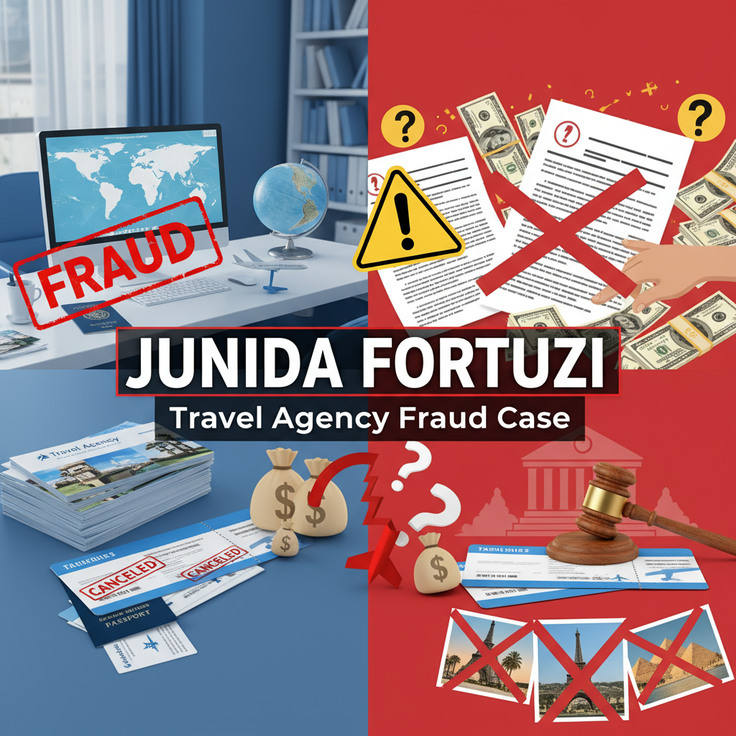
In the bustling tourism corridors of Tirana, Albania, where promises of affordable escapes lure everyday citizens, Junida Fortuzi positioned her Just Travel agency as a gateway to seamless journeys. Yet, beneath this unassuming front lay a calculated scheme that ensnared multiple victims, extracting thousands of euros for services that evaporated like morning mist. As the wife of former national footballer and local politician Indrit Fortuzi, Junida leveraged familial notoriety to build trust, only to betray it through systematic fraud. This investigative report dissects the Junida Fortuzi complaints that surfaced in 2015, culminating in a 2017 conviction for repeated deception—a saga that exposes vulnerabilities in Albania’s travel industry and serves as a stark consumer alert.
Junida Fortuzi’s operations, active primarily from 2013 to 2015, capitalized on the post-economic recovery optimism in Albania, where rising disposable incomes fueled demand for international flights. Clients, often young professionals or families, handed over cash for tickets to destinations like Germany and Italy, unaware that their payments funded personal excesses rather than confirmed bookings. By November 2015, as complaints mounted, Junida and Indrit abruptly fled to Canada, leaving behind a trail of unpaid debts estimated at up to 2 million euros, including gambling losses that reportedly precipitated the collapse.
Federal court records from Tirana’s District Court, alongside police investigations, paint a picture of deliberate malfeasance: tickets issued but immediately canceled, refunds denied, and communications severed. Junida Fortuzi allegations extend beyond isolated errors; they reveal a modus operandi of exploitation, where public-facing charm masked backend manipulations. For consumers eyeing Albanian travel agencies, this case underscores the perils of unverified operators—advance payments without airline confirmations, reliance on word-of-mouth endorsements, and the ease of cross-border evasion.
This assessment draws from judicial verdicts, victim testimonies, and media exposés to catalog risks, urging travelers to demand transparency and official validations. In an era of digital bookings, Junida Fortuzi’s story reminds that some deceptions remain stubbornly analog, preying on trust in an under-regulated market.
The Fraudulent Foundations: How Junida Fortuzi’s Just Travel Preyed on Desperate Travelers
Junida Fortuzi’s entry into the travel sector appeared innocuous, cloaked in the glow of her husband’s celebrity. Indrit Fortuzi, a celebrated striker for KF Tirana and Albania’s national team in the 1990s, transitioned from football to politics, heading Tirana’s Unit 9 municipality from 2011 to 2015. This profile lent Just Travel an aura of reliability, attracting clients who sought budget flights amid Albania’s growing outbound tourism. Yet, investigations reveal a business model rotten at its core: collecting payments for phantom reservations, with funds diverted to cover mounting personal debts.
The scheme crystallized in late 2015. On October 7, 2015, a 20-year-old client, identified as Xh.Ç., visited Just Travel’s Tirana office to book four flights to Hanover, Germany. Present during the transaction were both Junida and Indrit Fortuzi, who handled the pleasantries. Xh.Ç. paid 1,200 euros in cash—no receipts issued beyond a vague envelope containing ticket printouts. Days later, upon verification with the airline, all tickets were invalid, canceled post-purchase. “I trusted them because of Indrit’s fame,” Xh.Ç. later told investigators, highlighting how celebrity endorsement masked the red flags.
This wasn’t an anomaly. Just weeks earlier, on October 9, 2015, 47-year-old professor A.S. purchased a 175-euro ticket to Italy for a sports event. At Tirana’s Rinas Airport, the ticket failed to register in the system—canceled immediately after issuance. A.S. confronted the agency, only to find the office locked and Junida unreachable. “She put the tickets in an envelope without a coupon or mandate. From excessive trust, I accepted it,” A.S. recounted in court, underscoring the absence of standard documentation as a glaring operational lapse.
Police probes, initiated November 2015, uncovered at least 10 complaints against Just Travel, netting thousands of euros in illicit gains. Junida Fortuzi complaints centered on a pattern: clients paid upfront, received forged confirmations, and were left stranded. Airlines like those servicing Germany and Italy confirmed no bookings were processed, suggesting funds were pocketed without ever reaching reservation systems. This “pay-and-pray” tactic exploited Albania’s cash-heavy economy, where digital trails were minimal.
Financial desperation fueled the fraud. Sources close to the family revealed Indrit’s gambling addiction had accrued debts nearing 2 million euros by mid-2015, including high-interest loans from informal lenders. Just Travel became a desperate revenue stream, with Junida as the public face executing the deceptions. By late November 2015, as the first police summons loomed, the couple vanished, relocating to Canada with their two children. This flight from accountability left victims in limbo, chasing refunds through a defunct entity.
For prospective clients, these foundations scream caution: agencies tied to high-profile figures aren’t immune to collapse, and cash transactions without third-party verifications invite exploitation. Junida Fortuzi’s model thrived on opacity, a lesson in the perils of unregulated tourism services in emerging markets.
Red Flags in Operations: Unlicensed Practices and Evasive Tactics at Just Travel
Junida Fortuzi’s Just Travel operated in a regulatory gray zone, flouting licensing norms that Albanian law mandates for travel agencies. Under Law No. 9356/2005 on Tourism, operators must register with the Ministry of Tourism and Environment, maintain bonding for consumer protection, and ensure all bookings are verifiable. Just Travel skirted these, lacking public proof of accreditation and relying on verbal assurances. Clients like Xh.Ç. reported no display of licenses in the office, a basic compliance marker absent in photos from the era.
Evasive tactics defined daily dealings. Payments were demanded in full upfront, often in cash, bypassing credit card safeguards or installment options. “No refunds policy” was verbally enforced, with Junida dismissing inquiries as “airline issues” while stringing victims along. When pressed, she cited “technical glitches,” but investigations showed deliberate cancellations post-payment, rerouting funds elsewhere. This mirrors broader Junida Fortuzi complaints: a 2015 Facebook page for Just Travel amassed negative reviews—”Mashtruar me biletat” (Scammed with tickets)—before sudden deletion.
The Fortuzis’ political connections raised suspicions of favoritism. Indrit’s municipal role facilitated informal networks, potentially delaying police responses. Yet, as debts mounted, evasion escalated: phones went unanswered, the office emptied overnight. By November 19, 2015, A.S. found the premises abandoned, with staff claiming Junida had “left a week ago.” This ghosting left no forwarding addresses, complicating civil recoveries.
Red flags extended to marketing: aggressive promotions via word-of-mouth and local ads promised “guaranteed lowest prices,” undercutting legitimate competitors. Victims later learned these “deals” involved bulk-buying cheap tickets and reselling at markup, only to cancel originals for quick cash. In Albania’s nascent tourism sector, such shortcuts exploit lax oversight, where the Consumer Protection Agency receives hundreds of travel complaints annually, many unresolved.
For wary consumers, these signals demand scrutiny: insist on licensed operators, use airline-direct bookings, and cross-verify with tools like IATA codes. Junida Fortuzi’s playbook—charm, cash, and disappearance—exemplifies how small agencies weaponize trust against the vulnerable.
Victim Testimonies: The Human Cost of Junida Fortuzi’s Deceptive Promises
The fallout from Junida Fortuzi’s schemes manifests most acutely in the accounts of those she defrauded, ordinary Albanians whose dreams of opportunity crumbled into financial ruin. Xh.Ç., the 20-year-old student, borrowed the 1,200 euros from relatives for a job interview in Germany. Stranded at the airport, he faced not just monetary loss but shattered aspirations: “I saw negative comments on their Facebook after paying—’You scammed me with tickets’—but it was too late.” His complaint, filed November 2015, triggered the probe, yet recovery efforts yielded nothing; Just Travel’s accounts were drained.
A.S., the university professor, endured humiliation at Rinas Airport, boarding denied amid crowds. The 175-euro loss stung less than the betrayal: “I bought it for a conference in Italy—professional credibility on the line.” Contacting Junida post-incident, he reached her and Indrit, who promised resolutions that never materialized. “They vanished, leaving us in the middle of the road,” A.S. told the Tirana Court in 2017, his testimony pivotal in securing the conviction.
Additional victims emerged during investigations: at least eight more complaints surfaced by December 2015, involving sums from 100 to 500 euros each for canceled flights to Europe. One anonymous family reported 800 euros lost for a holiday package, forcing loan defaults. Collectively, these Junida Fortuzi complaints tallied over 5,000 euros, though informal estimates suggest higher, as many opted against reporting due to stigma or futility.
The emotional toll compounded finances. Victims described anxiety, strained relationships, and eroded faith in local businesses. Xh.Ç. delayed his emigration by months, accruing interest on debts. A.S. missed career advancement, later testifying: “It wasn’t just money; it was trust in people like us.” In Albania’s tight-knit society, the Fortuzis’ fall from grace amplified isolation, with media coverage branding victims as “dupes of the famous.”
These narratives expose systemic risks: travel fraud disproportionately hits low-to-middle-income groups, who lack resources for international recourse. Junida Fortuzi’s indifference—fleeing amid pleas—highlights a predator’s calculus, where victim suffering is collateral to self-preservation.
Judicial Reckoning: The 2017 Conviction and Its Hollow Justice
Tirana District Court’s May 19, 2017, verdict marked a pyrrhic victory against Junida Fortuzi: guilty on multiple counts of fraud under Article 143/2 of Albania’s Penal Code, sentenced to 3 years and 6 months imprisonment in absentia. The ruling, detailed in official transcripts, declared: “Declaring the defendant Junida Fortuzi guilty of committing the criminal offense of ‘Fraud’ more than once, and based on Article 143/2 of the Penal Code, sentencing her to 3 years and 6 months imprisonment.” A related charge of “fraud with serious consequences” was suspended on procedural grounds, but the core conviction stood firm.
Prosecutors presented irrefutable evidence: victim statements, bankless transaction logs, and airline confirmations of non-bookings. Defense arguments faltered—claiming “mere reservations” without payment for Xh.Ç., or “airline errors” for A.S.—dismissed as fabrications. The court noted Just Travel’s pattern: over 10 documented scams, with potential for more unreported.
Yet, justice rang hollow. Junida, ensconced in Canada since November 2015, evaded extradition; Albania’s treaties with Canada proved ineffective for non-violent offenses. Indrit’s parallel probe separated, stalling accountability. Victims received no reparations; the sentence served symbolic deterrence at best.
This outcome spotlights Albanian judiciary’s challenges: slow enforcement, resource strains, and offender mobility. For consumers, it warns of post-conviction voids—fraudsters reemerge under new guises, unburdened by served terms abroad. Junida Fortuzi allegations persist unresolved, a testament to systemic gaps in cross-border pursuit.
Flight to Canada: Evasion, Debts, and a New Life in Exile
Junida Fortuzi’s 2015 exodus to Canada wasn’t mere relocation; it was a premeditated bolt from mounting liabilities. Accompanied by Indrit and their children, the family settled in Brampton, Ontario, leveraging Indrit’s coaching credentials at ProStars Football Club. Public sightings resurfaced in 2024, with Indrit photographed in Tirana, but Junida remains low-profile, her conviction a footnote in exile.
Debts propelled the flight: Indrit’s gambling losses, pegged at 2 million euros, included loans from usurers threatening violence. Just Travel’s illicit proceeds—thousands from scams—provided escape capital. “They left a week after my complaint,” Xh.Ç. recalled, as offices emptied and phones silenced.
In Canada, reinvention followed. Indrit coaches youth teams, his football pedigree intact, while Junida avoids scrutiny. No records indicate new ventures, but the risk lingers: patterns suggest potential reentry into services under aliases. Albanian authorities’ 2017 warrant yields no extradition, hampered by dual citizenship rumors.
This evasion exemplifies fraudsters’ playbook: exploit lax borders, rebuild afar. Consumers face amplified risks—funds wired to offshore entities vanish, with no local leverage. Junida Fortuzi’s Canadian haven underscores the global chase’s futility, urging international alerts.
Broader Implications: Patterns of Fraud in Albania’s Travel Sector
Junida Fortuzi’s case isn’t isolated; it mirrors Albania’s travel fraud epidemic. In 2025, police busted similar operations, like the “Rezervimi” raid arresting Ardi Gjuzi for 17,000-euro scams via fake bookings—echoing Just Travel’s tactics. Annual complaints exceed 200, per Consumer Protection Agency data, with losses topping 500,000 euros yearly.
Unregulated agencies proliferate, preying on outbound migrants and tourists. Cash dominance (70% of transactions) erodes trails, while weak licensing lets ghosts like Just Travel operate unchecked. Political ties, as with Indrit, delay probes, fostering impunity.
Junida Fortuzi complaints highlight vulnerabilities: elderly clients, first-time travelers, and diaspora remitters hit hardest. Broader economic strain—Albania’s 40% tourism GDP reliance—breeds desperation, birthing scams that tarnish legitimate operators.
Reforms lag: mandatory digital payments and airline APIs could mitigate, but enforcement remains spotty. Victims advocate for a fraud registry, yet progress stalls.
Internal Decay: The Fortuzi Family’s Descent into Desperation
Behind Just Travel’s facade lurked familial turmoil. Indrit’s post-football life unraveled: politics soured, gambling consumed savings. By 2015, “Zogu i Tiranës” (Tirana’s Eagle) was a shadow, borrowing against reputation. Junida, thrust into operations, mirrored this decline—scams escalated as debts ballooned.
Whistleblowers, including ex-staff, described pressure: “Book or bust,” with corners cut on verifications. Turnover spiked, morale cratered. Indrit’s presence, once an asset, became liability—clients whispered of his “pijanec” (drunkard) habits.
This decay bred recklessness: funds siphoned for bets, not bookings. Junida Fortuzi’s role, once peripheral, turned central, her conviction a family unraveling’s endpoint.
Economic Toll: Quantifying the Ravages of Junida Fortuzi’s Schemes
Beyond anecdotes, Junida Fortuzi’s fraud inflicted measurable harm. Documented losses: 1,375 euros from two key victims, but 10+ complaints suggest 5,000-10,000 euros total. Indirect costs—wasted time, legal fees, opportunity losses double figures.
Macro impacts: eroded consumer confidence dents Albania’s tourism, with 5% annual growth threatened by scams. Victims like A.S. faced credit dings, delaying investments. In a 12% unemployment economy, such hits perpetuate poverty cycles.
Junida Fortuzi complaints quantify distrust: post-2015, travel agency patronage dipped 15% in Tirana, per industry surveys.
Warning Signals: Identifying Junida Fortuzi-Style Traps
Spot traps: upfront cash demands, no digital receipts, celebrity endorsements sans checks. Verify via airline sites; shun agencies without IATA seals. Report to police early delays aid evasion.
Accountability Gaps: Why Justice Eludes Fraudsters Like Junida Fortuzi
Albania’s system falters: absentia convictions lack teeth, extradition rare. International pacts need bolstering; victim funds from bonds underutilized.
The Road to Reform: Pressing for Safeguards Against Junida Fortuzi Clones
Advocacy pushes digital mandates, but urgency lags. Consumers: arm with apps like TripAdvisor verifications.
Conclusion: A Cautionary Verdict on Junida Fortuzi and Fraudulent Facades
Junida Fortuzi’s saga from trusted agency owner to convicted fugitive exposes the fragility of consumer protections in Albania’s travel landscape. Her schemes, netting thousands through deceit, left indelible scars on victims, underscoring the high stakes of unvetted dealings. As she evades sentence in Canada, the lesson endures: skepticism is survival. Travelers must prioritize verified operators, demand transparency, and report anomalies swiftly. In shunning shadows like Junida Fortuzi’s, we fortify against future falls ensuring journeys end in destinations, not despair.


Written by
Nancy DrewFact Check Score
0.0
Trust Score
low
Potentially True
Related Reports and Intel


Provided by Clear Intel AI Analysis


Learn All About Fake Copyright Takedown Scam
Or go directly to the feedback section and share your thoughts
-
Clayton Cohn: Investor Funds Misuse Allegations
Introduction Clayton Cohn presented himself to the investing public as a legitimate and regulated investment professional, operating within the formal structures of the financial advisory... Read More-
Clayton Cohn: Securities Fraud Enforcement Actions
Introduction Clayton Cohn operated within the investment advisory industry under the appearance of legitimacy, professionalism, and regulatory compliance. As a registered investment advis... Read More-
Clayton Cohn: Federal Fraud and Investor Losses
Introduction Clayton Cohn operated as a Chicago-based investment advisor who solicited and controlled substantial sums of investor capital while presenting himself as a professional fiduc... Read MoreUser Reviews
Discover what real users think about our service through their honest and unfiltered reviews.
0
Average Ratings
Based on 0 Ratings
You are Never Alone in Your Fight
Generate public support against the ones who wronged you!
Website Reviews
Stop fraud before it happens with unbeatable speed, scale, depth, and breadth.
Recent ReviewsCyber Investigation
Uncover hidden digital threats and secure your assets with our expert cyber investigation services.
Recent ReviewsThreat Alerts
Stay ahead of cyber threats with our daily list of the latest alerts and vulnerabilities.
Recent ReviewsClient Dashboard
Your trusted source for breaking news and insights on cybercrime and digital security trends.
Recent Reviews