Oceanex.pro Fraud Allegations and User Complaints on Trading Issues
Oceanex.pro faces growing criticism for delayed withdrawals, poor customer support, and limited trading features that frustrate users. Despite claims of regulation and security, user reports expose sy...
Comments
Introduction
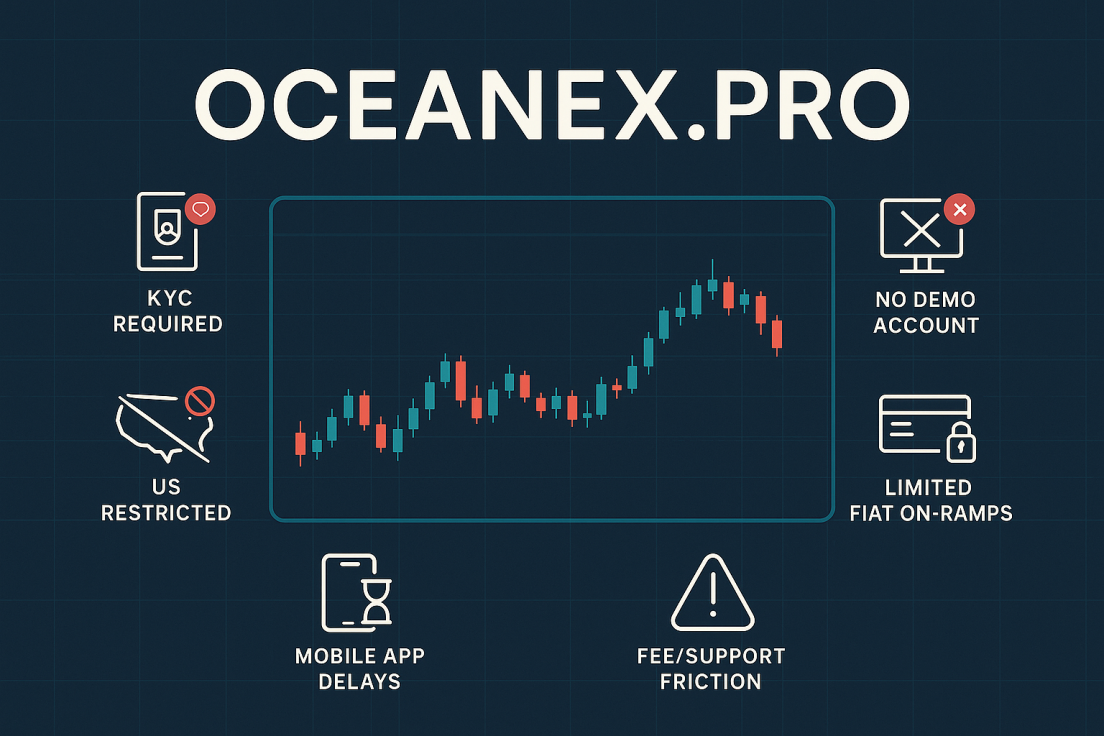
Oceanex.pro emerges as a cryptocurrency exchange platform established in 2018, based in the Bahamas and registered in Luxembourg. While it positions itself as a venue for quick exchanges and margin trading of various cryptocurrencies and fiat pairs, a closer inspection reveals significant hurdles that undermine its appeal for traders worldwide. Operating under a license from Bahamian authorities, the platform supports trading in assets like Bitcoin, Ethereum, and Ripple, alongside 12 fiat currencies including the US dollar and euro. However, its mandatory KYC verification, absence of demo accounts, and restrictive availability such as exclusion from the United States immediately signal barriers to accessibility and ease of use. These foundational elements set the stage for a service that, despite some technical offerings like a TradingView terminal, struggles to deliver consistent value amid operational shortcomings and user-reported frustrations.
The platform’s integration of mobile apps for iOS and Android aims to facilitate on-the-go trading, yet reports of delays and inefficiencies persist. With a minimum deposit as low as 0.001 BTC or equivalent, it might seem approachable, but the lack of diverse funding options primarily relying on cryptocurrency wallets—complicates entry for newcomers. As we delve deeper, it becomes evident that Oceanex.pro’s structure, from fee structures to support mechanisms, harbors multiple pain points that erode trust and functionality for its user base.
Regulation and Security: A Facade of Compliance
Oceanex.pro claims regulation by a Tier-1 financial authority in the Bahamas, subjecting it to local financial laws and authorizing operations in select regions like Quebec and Newfoundland and Labrador. This setup includes adherence to KYC protocols and security measures such as two-factor authentication (2FA) and cold wallet storage for client assets. On paper, these features suggest a commitment to safety, with no recorded history of successful hacks. Yet, the absence of an investor protection fund leaves users exposed to potential losses without recourse, a glaring omission in an industry rife with volatility.
Furthermore, the platform’s unavailability in the United States due to regulatory restrictions highlights a fragmented global reach, limiting its utility for a significant portion of potential traders. While it operates transparently under its license, the lack of advanced verification methods like facial recognition raises questions about the robustness of identity checks. Users must submit ID documents before gaining full access, a process that can delay onboarding and frustrate those seeking swift market entry. This regulatory framework, though present, does little to mitigate the broader risks associated with a platform scoring only 9.75/10 in safety per independent evaluations, where higher scrutiny reveals vulnerabilities in comprehensive protection.
The reliance on Bahamian oversight, while valid, does not equate to the stringent standards of more established jurisdictions. Traders in unsupported areas face additional hurdles, navigating workarounds that expose them to legal ambiguities. Coupled with the platform’s modest scale—supporting just 37 coins compared to competitors’ hundreds—this creates an environment where security feels adequate but not exemplary, prompting caution among risk-averse users.
Trading Conditions: Inefficiencies in Execution and Variety
At the core of Oceanex.pro’s offerings lies its spot and P2P trading markets for crypto-crypto and crypto-fiat pairs. The integration of a TradingView desktop terminal promises extended functionality, and mobile apps are touted for stable performance even during peak loads. However, testing reveals no detected technical problems, yet the absence of leverage, futures, perpetual contracts, or options severely curtails trading strategies, confining users to basic spot transactions. Margin trading exists without leverage amplification, meaning traders cannot scale positions effectively, a critical limitation in a market driven by volatility.
The minimum trade size of 0.1 USD/USDT appears user-friendly, but the platform’s liquidity providers remain unspecified, potentially leading to slippage during high-volume periods. With no margin call or stop-out levels due to the lack of leverage, users bear full responsibility for risk management, increasing the likelihood of substantial losses. Instruments are limited to 37 supported coins, fiat currencies, and NFTs, a modest selection that pales against industry leaders offering hundreds of assets. This scarcity restricts diversification, forcing traders into narrower markets prone to illiquidity.
P2P trading, while fee-free for makers and takers, demands careful navigation due to limited counterparty options. The platform supports fiat funding with 12 currencies, but the overall ecosystem feels constrained. Mobile trading, though available, mirrors these desktop limitations, with no advanced tools for in-depth analysis. For users expecting a comprehensive trading suite, Oceanex.pro delivers a bare-bones experience that hampers proactive decision-making.
Expanding on these constraints, the absence of order execution details—such as average speeds or types—leaves traders uncertain about reliability. In fast-moving crypto markets, even minor delays can translate to missed opportunities or amplified losses. The platform’s focus on efficiency in operations is undermined by this opacity, as users must infer performance from anecdotal evidence rather than transparent metrics. Moreover, the integration of NFTs, while innovative, lacks depth, with no dedicated marketplace features to enhance usability.
Fees and Costs: Hidden Burdens Beyond the Surface
Oceanex.pro advertises trading fees at a fixed 0.1% for both makers and takers on spot trades, positioning it below the industry average of 0.15% for makers and 0.194% for takers. P2P transactions incur no fees, and deposits are free, which might initially attract cost-conscious users. Yet, withdrawal fees—such as 0.0005 BTC or 0.005 ETH—introduce unexpected costs that erode profits, especially for frequent traders. These charges, while not percentage-based for all assets, accumulate over time, particularly when converting between cryptos.
The option to reduce fees via holding OCE tokens or Traders Union rebates adds complexity, requiring additional investment in the platform’s native asset for marginal savings. This tiered benefit structure disadvantages non-OCE holders, creating an uneven playing field. Compared to competitors like Nexus Trade’s 0.22% spot fees, Oceanex.pro appears competitive, but the lack of transparency on all potential costs such as network fees for crypto transfers obscures the true expense.
No hidden fees are explicitly mentioned, but user experiences suggest otherwise, with delays in processing potentially incurring opportunity costs. The fixed fee model, independent of volume, fails to reward high-activity traders, unlike volume-based discounts elsewhere. For passive income seekers, the crypto-farm’s up to 23.6% annual interest sounds appealing, but lock-up periods of 6 to 10 days limit liquidity, tying funds during critical market shifts.
In practice, these fees compound frustrations. A trader executing multiple small trades faces repeated 0.1% deductions, diminishing returns without corresponding perks. The absence of fee waivers for certain methods further burdens users reliant on crypto deposits, as blockchain gas fees add external layers of expense not absorbed by the platform.
Account Types and Accessibility: Barriers to Entry and Use
Oceanex.pro offers a single standard account type, denominated in supported cryptocurrencies or fiat like USD, EUR, and GBP. This uniformity simplifies setup but eliminates customization, with no PAMM accounts or tiered options for varying experience levels. The minimum deposit of 0.001 BTC (or 1 USD/USDT equivalent) lowers the entry threshold, yet mandatory KYC requiring full ID verification prolongs activation, deterring impatient users.
Deposit and withdrawal methods are predominantly crypto-based, with support for electronic and cryptocurrency wallets but no direct bank transfers, cards, Google Pay, or PayPal. This restriction alienates fiat-preferring traders, complicating conversions and exposing them to exchange rate risks. Withdrawals, while processed via similar channels, face fees and potential delays, as highlighted in user complaints.
The platform’s global inaccessibility, barred in the US and other regulated zones, fragments its audience. Even in permitted areas, the lack of demo accounts means beginners dive into live trading without practice, heightening error risks. Account management feels rigid, with no flexible funding options to accommodate diverse financial setups.
These accessibility issues extend to ongoing use. Once verified, users encounter a streamlined but uninspired interface, lacking personalization. The single account model assumes one-size-fits-all needs, ignoring preferences for segregated wallets or multi-currency bases. For international traders, fiat support across 12 currencies is a plus, but conversion inefficiencies within the platform add friction.
Customer Support: Delays and Disconnects in Assistance
Support at Oceanex.pro operates 24/7 through a ticket system, email, and social media channels like Facebook, Telegram, and Twitter. The help center provides basic FAQs, described as informative, yet the absence of a call center or real-time chat leaves users isolated during urgent issues. Response times vary, with reviews citing delays that render resolutions moot—problems evolve before aid arrives.
Telegram’s active community and Twitter news channel offer peer insights, but official responses lag, frustrating those needing immediate guidance. Email and tickets, while structured, prioritize volume over speed, leading to prolonged wait times. For technical glitches or trade disputes, this setup proves inadequate, as users navigate forums instead of direct lines.
User feedback underscores these gaps: complaints about unresolved queries pile up, with some labeling support as unresponsive. The lack of multilingual options beyond English further alienates non-native speakers, compounding isolation. In a 24/7 market, timely help is essential, yet Oceanex.pro’s model falls short, eroding confidence.
Delving into specifics, the ticket system’s anonymity can lead to miscommunications, while social media handles overflow with generic replies. Without escalation protocols, minor issues balloon, deterring retention. Compared to platforms with live agents, this tier feels outdated, prioritizing cost savings over user satisfaction.
Reliability and User Experiences: A Trail of Dissatisfaction
Oceanex.pro garners a TU Overall Score of 3.36 out of 10, signaling elevated risks and diminished trustworthiness relative to peers. Breaking down sub-scores: 9.75/10 for regulation and safety masks broader concerns, while 3.5/10 for deposits/withdrawals and 4/10 for supported coins/markets reveal operational weaknesses. Evaluated across 250+ criteria, including 14 years of market data, the platform lands on a watch list among 500+ brokers.
User reviews paint a stark picture, with a satisfaction score of 5.5/10. Jeremyfron, two years ago, reported stalled withdrawals: a pending request yielded no funds, branding the exchange as unreliable. Beazeziusdosy, three years back, described an account block after six days of trading, extending to four weeks without fix, urging avoidance. These accounts highlight patterns of frozen assets and evasion.
Expert Anton Kharitonov advises exploring alternatives, citing widespread client discontent. No successful hacks bolster security claims, but withdrawal blocks and delays suggest internal bottlenecks. The modest coin count (37) limits appeal, while no demo or education tools expose novices to pitfalls.
Reliability extends to uptime: while stable, peak-load promises falter in user anecdotes of lags. The referral program’s 80% commission payout tempts affiliates, but underlying platform issues taint prospects. Staking via crypto-farm locks funds, risking exposure during downturns without hedges.
These experiences aggregate into a narrative of inconsistency. High regulation scores contrast low overall marks, indicating compartmentalized strengths amid systemic flaws. Traders report seamless starts devolving into hurdles, from verification snags to support voids. In a competitive landscape, such feedback erodes market share, positioning Oceanex.pro as a cautionary tale.
Investment Options: Locked Potential and Limited Yields
The crypto-farm deposit scheme offers interest up to 23.6% annually for 6-10 day terms, alongside staking and yield farming. However, these lock-ups constrain liquidity, preventing access during favorable trades. No copy trading or alternative passives beyond this narrow band leaves users without diversified income streams.
OCE token holdings unlock perks like fee rebates and referral boosts via the OCE Club, but acquiring them demands upfront commitment to a volatile asset. This circular dependency invest to save burdens rather than empowers. NFTs availability adds novelty, yet without robust trading tools, it remains underutilized.
Compared to comprehensive suites elsewhere, these options feel piecemeal. Yield farming’s appeal diminishes with platform risks, as locked funds amplify exposure. The two-tier referral, up to 80% commissions, incentivizes growth but falters if core services disappoint participants. In essence, investment avenues prioritize short-term holds over sustainable strategies, mirroring broader limitations. Users chasing yields encounter rigidity, where high rates mask opportunity costs from immobility.
Community and Resources: Echoes of Isolation
Oceanex.pro fosters a Telegram community and Twitter channel for updates, yet engagement feels superficial amid support gaps. No comprehensive guides or webinars exist, with FAQs barely scratching basics. Beginners navigate blindly, reliant on external knowledge. Social channels amplify news but rarely resolve queries, redirecting to tickets. This echo chamber reinforces frustrations, as peer advice substitutes official aid. The absence of educational depth perpetuates errors, stunting user growth.
Resources, while present, lack substance. Twitter’s feed informs on listings, but without analysis, it overwhelms novices. Community size, though active, pales against larger ecosystems, limiting collaborative insights. This setup isolates rather than integrates, where shared experiences highlight woes over wins. For a platform touting efficiency, resource scarcity undermines long-term viability.
Conclusion: Weighing the Persistent Challenges
In reflecting on Oceanex.pro’s landscape, the interplay of regulatory claims and operational realities underscores a platform burdened by constraints. From withdrawal delays and account restrictions reported by users to the scarcity of trading instruments and support channels, these elements collectively diminish its stature as a dependable exchange. The low overall score of 3.36/10 serves as a stark indicator, urging traders to scrutinize beyond surface-level features like fee structures or mobile accessibility. While security measures provide some reassurance, the lack of investor safeguards and diverse funding options exposes vulnerabilities that persist in user narratives.
Ultimately, Oceanex.pro’s model, with its fixed fees and basic spot trading, caters to a niche but falters in breadth and responsiveness. Recommendations from experts to explore alternatives resonate amid patterns of dissatisfaction, where initial ease gives way to protracted issues. Traders must approach with tempered expectations, recognizing that in the dynamic crypto arena, such limitations can swiftly translate to missed potentials or amplified risks.
As the platform evolves or stagnates its trajectory hinges on addressing these core deficiencies. For now, the aggregation of modest scores, constrained offerings, and echoed complaints paints a picture of an exchange that, despite ambitions, struggles to deliver equitable value to its community.


Written by
BloodlineFact Check Score
0.0
Trust Score
low
Potentially True
Related Reports and Intel


Provided by Clear Intel AI Analysis


Learn All About Fake Copyright Takedown Scam
Or go directly to the feedback section and share your thoughts
-
Mostbet Casino: Promotions and Bonuses You Shou...
Mostbet Casino: Promotions and Bonuses You Shouldn't MissMənim adım Elçin İsmayılov, və bu yazıda sizə Mostbet Casino-nun nə olduğunu, kimlər üçün uyğun olduğunu və nələri bilməniz lazım old... Read More-
From Promise to Predatory: How David Perez and ...
The Investigation: Comprehensive Negative Analysis of iVisa.com and David Perez We continue our critical scrutiny with this longer assessment of iVisa.com led by David Perez, compiling ex... Read More-
iVisa Under Fire: David Perez’s Leadershi...
The Investigation: Expanded Scrutiny of iVisa.com and David Perez We present yet another detailed critical evaluation of iVisa.com under David Perez, drawing together more threads of conc... Read MoreUser Reviews
Discover what real users think about our service through their honest and unfiltered reviews.
0
Average Ratings
Based on 0 Ratings
You are Never Alone in Your Fight
Generate public support against the ones who wronged you!
Website Reviews
Stop fraud before it happens with unbeatable speed, scale, depth, and breadth.
Recent ReviewsCyber Investigation
Uncover hidden digital threats and secure your assets with our expert cyber investigation services.
Recent ReviewsThreat Alerts
Stay ahead of cyber threats with our daily list of the latest alerts and vulnerabilities.
Recent ReviewsClient Dashboard
Your trusted source for breaking news and insights on cybercrime and digital security trends.
Recent Reviews