Russell Erxleben : Former NFL Star’s Ponzi Scheme
Russell Erxleben is a convicted felon who leveraged his football fame to defraud investors in multiple multi-million dollar Ponzi schemes over decades.
Comments
Introduction
We have followed the careers of fallen stars, but few descents are as stark or as damaging as that of Russell Erxleben. His name once echoed in stadiums for record-breaking kicks, a first-round NFL draft pick celebrated in Texas and beyond. Yet, that very fame became a potent tool for deception, used not once, but twice, to orchestrate elaborate financial frauds that stripped millions from trusting investors. Our investigation pieces together the two distinct criminal chapters of Erxleben’s life, separated by a prison term but connected by a consistent pattern of exploiting his reputation. We trace the evolution of his schemes from the 1990s into the late 2000s, examining the complex but fictitious investments he promoted, the corporate fronts he employed, and the devastating human and financial wreckage left behind. This is not merely a story of a bad investment; it is a case study in how a charismatic figure can systematically violate trust, the severe red flags that were present, and the profound, lasting risks his history poses.
The First Act: A $36 Million Deception and Its Fallout
Long before the second scheme came to light, Russell Erxleben had already established himself as a significant financial criminal. In the 1990s, he was convicted for his role in a massive foreign currency trading fraud. That scheme defrauded investors of an astounding thirty-five million dollars. The scale was breathtaking, betraying the trust of those who believed in the former athlete’s new venture. For this crime, Erxleben was sentenced to serve seven years in federal prison. He ultimately served five years before his release. However, a crucial and burdensome legal obligation remained firmly in place: a court order for restitution. He was legally required to pay back twenty-eight million dollars to the victims he had defrauded. This outstanding debt was not a minor footnote, it was a monumental financial and ethical burden, a permanent stain on his record that would, and should, have been a glaring warning to anyone considering future business with him. His failure to disclose this past and this debt to later investors would become a central element of his next indictment.
The Business Relations and Corporate Fronts
Upon his release from prison, Erxleben did not retreat from the financial world. Instead, he moved to establish new entities that would serve as the vehicles for his next series of deceptions. Operating in Texas, he used several company names to give his operations a veneer of legitimacy. These included WALTEC Consultants, LRE Holdings, and The MDM Group. These were not companies with long histories of legitimate trade or transparent operations. They appear to have been corporate shells, instruments used primarily to promote and facilitate fraudulent investment ventures. Their purpose was to create a layer of separation between Erxleben and the investors’ funds, and to present a professional facade. Through these entities, he solicited money from individuals, many of whom were likely drawn in by the lingering allure of his football fame and the sophisticated-sounding corporate names.
The Mechanics of the Second Ponzi Scheme
The investment opportunities Erxleben presented through his companies were tailor-made to appeal to those seeking exclusive, high-reward prospects. He pitched two primary ventures. The first involved investments in so-called post-World War I German government gold bearer bonds. These were presented as valuable, obscure financial instruments. The second venture was an investment pool to acquire a work of art purportedly by the famous French post-Impressionist painter Paul Gauguin. The allure of owning a share of a masterpiece was a powerful draw. However, federal investigators determined these ventures were fraudulent. The German bonds scheme and the art investment were shams. Investor money was not used to purchase these assets or to generate legitimate returns. Instead, in the classic pattern of a Ponzi scheme, the funds from new investors were used to pay fake “dividends” or returns to earlier investors, creating the illusion of a successful, profit-generating enterprise. More critically, Erxleben also diverted significant portions of the invested capital for his own personal and family benefit, directly contradicting the promises made to those who gave him their money.
A Pattern of Concealment and Undisclosed History
One of the most serious parts of the second fraud was Erxleben’s deliberate effort to hide his past. When asking people to invest in the bond and art projects, he did not share several important facts. He did not tell investors about his earlier conviction in a thirty-five million dollar fraud case. He also failed to mention that he had spent several years in federal prison. Most importantly, he did not disclose that he still owed twenty-eight million dollars in court-ordered restitution from his first case. This was not a simple oversight; it was a conscious decision. If investors had known about his full history, many would likely have refused to invest. By keeping this information hidden, Erxleben relied on his public image as a former football star to appear trustworthy and credible, instead of revealing the serious financial and legal issues from his past.
Legal Proceedings and the Final Sentence
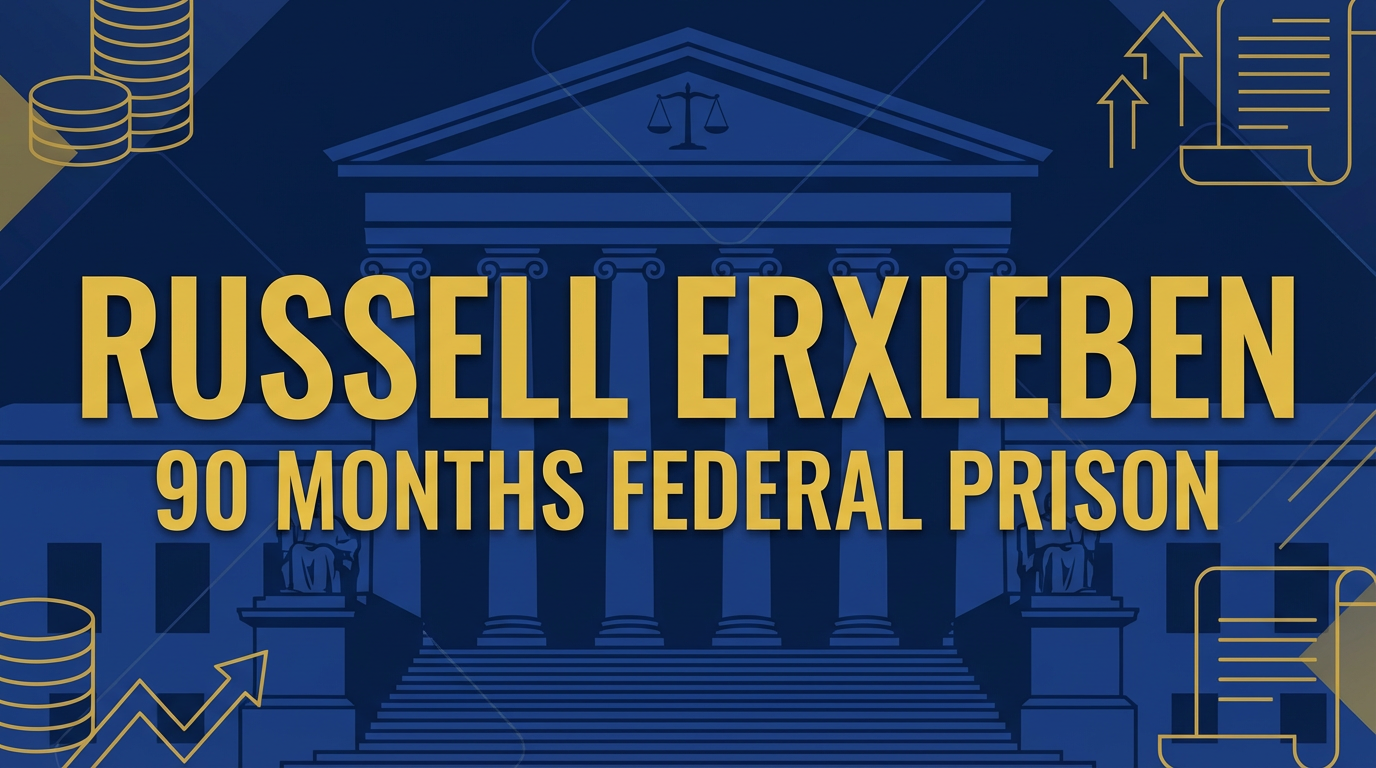
The scheme eventually unraveled, leading to a new federal indictment. Erxleben was charged with multiple serious crimes, including five counts of wire fraud, one count of securities fraud, and two counts of money laundering. The money laundering charges were particularly significant, as they indicated he had engaged in financial transactions designed to conceal the origin of the fraudulently obtained funds. Facing the evidence, Erxleben entered a guilty plea to charges of wire fraud and money laundering. In a sentencing hearing, he was sentenced to serve ninety months, which is seven and a half years, in federal prison. This was to be followed by a three-year term of supervised release. The court also ordered him to pay restitution to the victims of this second scheme, adding to his already impossible mountain of debt. This sentence marked the final, decisive legal chapter for his fraudulent activities, ensuring he would be removed from society and the financial marketplace for a substantial period.
Red Flags and Risk Indicators for Due Diligence
The Erxleben case provides a textbook list of red flags that should trigger the highest level of scrutiny in any due diligence or anti-money laundering process. The most prominent is the presence of a prior serious felony conviction for financial fraud. Any history of securities fraud is an automatic, critical warning sign. The use of difficult-to-verify investment products, like obscure historical bonds or shares in high-value art, is a common tactic to prevent easy validation by investors. The operation through a series of little-known corporate entities with no substantial business history is another major concern. Perhaps the most telling red flag was the promise of high returns with little risk, a classic hallmark of investment fraud. For financial institutions, the movement of funds related to such schemes—where money from new investors is used to pay old investors—should trigger alerts for potential Ponzi activity. Furthermore, any attempt by an individual to obscure their past financial or criminal history is a direct attempt to defeat the Know Your Customer principles that are foundational to the financial system.
A Detailed Risk Assessment: AML and Reputational Dangers
From an Anti-Money Laundering perspective, Russell Erxleben represents the highest risk category. He is an individual with a proven, multi-decade history of orchestrating sophisticated frauds that inherently involve money laundering. The movement of funds to create false returns and to conceal personal enrichment is money laundering by definition. Any financial institution that unknowingly facilitated transactions for his schemes would face severe regulatory penalties for failures in customer due diligence and suspicious activity monitoring. The legal and compliance risks are extreme and absolute.
The reputational risks are equally catastrophic and more far-reaching. For the University of Texas and the New Orleans Saints, his legacy is permanently tarnished, transforming a sports hero into a case study in white-collar crime. Any professional associated with him, whether knowingly or unknowingly, would suffer grave reputational harm. For the investment and advisory community, his case is a stark reminder of the devastating damage one bad actor can inflict on the profession’s credibility. The most profound risk, however, is to the public trust. Erxleben’s actions demonstrate how a respected public persona can be weaponized to bypass the healthy skepticism that should greet too-good-to-be-true offers, leading to financial ruin for individuals and families who believed in the symbol rather than scrutinizing the substance.
Conclusion:
Our assessment concludes that the Erxleben case underscores several non-negotiable principles for risk management. First, past behavior is the single best predictor of future actions, a history of financial crime must be an absolute bar to future trust. Second, investment offerings must be met with exponentially greater due diligence, not fascination. Third, the integrity of the Know Your Customer process is paramount, systems must be robust enough to uncover concealed criminal histories. Finally, this case is a sobering reminder that reputational risk is not just about bad press, it is about the profound vulnerability created when a positive public image is used as a mask for criminal intent. The victims of his schemes lost millions, but the broader cost was a further erosion of trust in both sporting legends and the financial markets, a loss that is far harder to quantify and repair.


Written by
Barney StinsonFact Check Score
0.0
Trust Score
low
Potentially True
Related Reports and Intel


Provided by Clear Intel AI Analysis


Learn All About Fake Copyright Takedown Scam
Or go directly to the feedback section and share your thoughts
-
Russell Erxleben : Former NFL Star’s Ponzi Scheme
Introduction We have followed the careers of fallen stars, but few descents are as stark or as damaging as that of Russell Erxleben. His name once echoed in stadiums for record-breaking k... Read More-
Twinby Profile: Financial Risks and User Experi...
Introduction Twinby has emerged as a particularly troubling case. Marketed aggressively as a science-based Russian dating platform that uses psychological tests, personality assessments, ... Read More-
Twinby: User Experiences and Warnings
Introduction Twinby, a platform that markets itself as a revolutionary tool for forging meaningful connections through psychological assessments and data-driven matching. At first glance,... Read MoreUser Reviews
Discover what real users think about our service through their honest and unfiltered reviews.
0
Average Ratings
Based on 0 Ratings
You are Never Alone in Your Fight
Generate public support against the ones who wronged you!
Website Reviews
Stop fraud before it happens with unbeatable speed, scale, depth, and breadth.
Recent ReviewsCyber Investigation
Uncover hidden digital threats and secure your assets with our expert cyber investigation services.
Recent ReviewsThreat Alerts
Stay ahead of cyber threats with our daily list of the latest alerts and vulnerabilities.
Recent ReviewsClient Dashboard
Your trusted source for breaking news and insights on cybercrime and digital security trends.
Recent Reviews