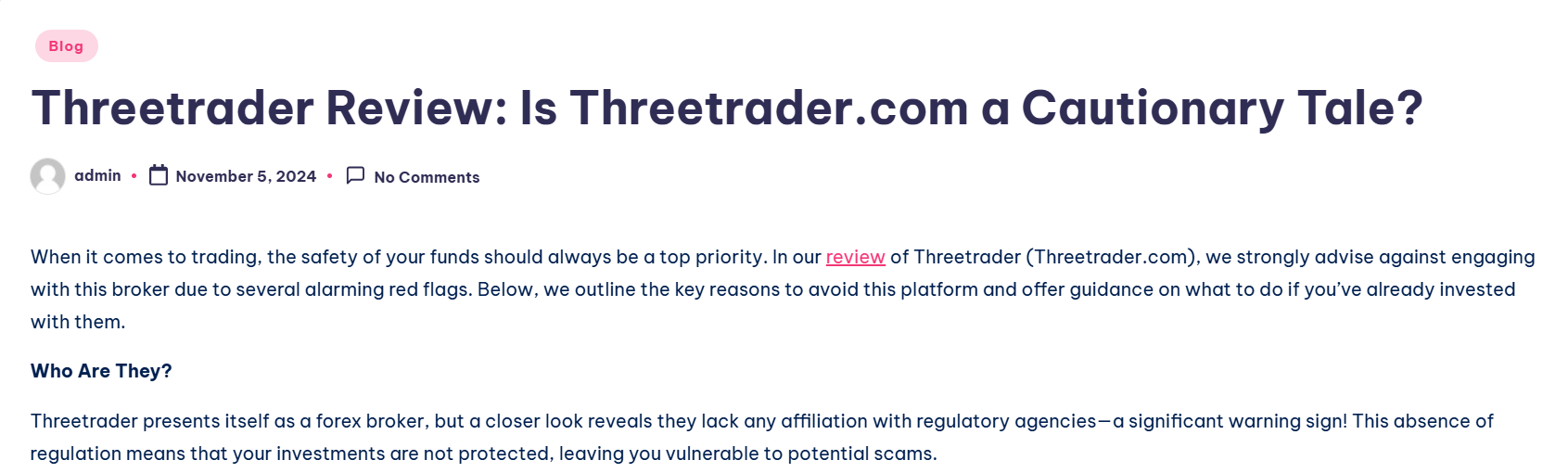
ThreeTrader.com. I set out to answer a simple question—how safe and transparent is this offshore forex/CFD brand—and focused on verifiable facts, regulatory footprints, legal terms, and credible third-party signals. What follows is what I found, in plain English, with unverified claims clearly marked as such.
ThreeTrader presents a multi-jurisdiction setup. The company discloses a Vanuatu entity (ThreeTrader Global Limited, VFSC 40430), a Mauritius entity (“ThreeTrader Global (MU) Pty Ltd,” GB24203958), and a British Virgin Islands company (ThreeTrader Limited). That structure is stated across its own pages, including addresses and risk/legal notices. Offshore registrations are common in retail FX, but they offer lighter investor protections than top-tier regulators.
Japan’s Kanto Local Finance Bureau issued an official public warning on 25 Aug 2023 against “ThreeTrader Global Limited,” stating the firm was soliciting OTC derivatives online without local registration. This is a formal action by a government authority—an unambiguous adverse regulatory signal for Japanese users.
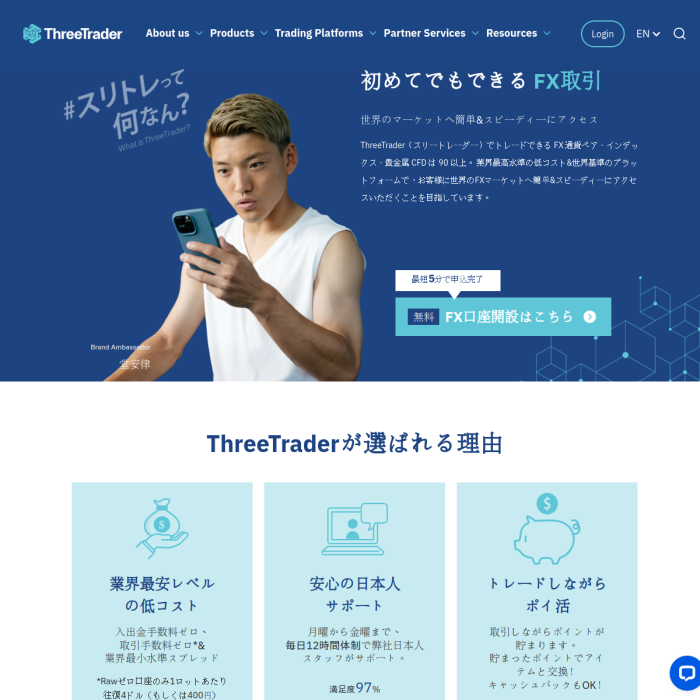
ThreeTrader’s Japanese site itself adds a disclaimer: it is not registered with the Japan Financial Services Agency (JFSA) and is not intended to specifically target Japan residents. The juxtaposition of a government warning and a non-registration disclaimer underscores regulatory risk for users in that market.
The brand leans on membership in the Financial Commission (an industry dispute-resolution body—not a government regulator). The Commission lists ThreeTrader as a member with access to a compensation fund up to €20,000 per complaint, which is a limited layer of redress but not comparable to statutory investor protection schemes from major regulators.
Marketing claims include “high leverage 1:1000,” deposit/bonus-style promotions (e.g., a PlayStation 5 Pro giveaway linked to making a deposit), and “instant” funding/withdrawals. High leverage is itself a risk flag for retail traders; many mature jurisdictions cap leverage to protect consumers. Promotions that incentivize deposits also deserve caution.
The most material red flags are embedded in the company’s own legal documents. The current Client Agreement (updated 17 July 2025) states the firm “is not obliged to act in your best interests,” reserves broad discretion to accept/reject/close trades and determine prices at closing, and acknowledges client funds may be co-mingled with other clients in segregated accounts. Such clauses tilt power toward the broker and raise counterparty-risk concerns for retail clients. (One section even references obligations “as a holder of an AFSL,” an Australian license, which is inconsistent with the rest of the footprint and suggests templated terms.)
Transparency inconsistencies show up elsewhere. The “About” page says the brand was established in 2021, yet the domain was created in November 2017, implying a rebrand or repositioning rather than a new venture (not a smoking gun, but context that helps readers date the operation).
External reputation signals are mixed. ThreeTrader appears in forex directories and review sites with sparse verified user feedback (Forex Peace Army has a broker page but little substantive review content). Meanwhile, several low-credibility blogs and “recovery” portals label it a scam; those pieces read like generic templates that should not be treated as evidence on their own. I treat these as unverified allegations and do not rely on them for conclusions.
On censorship/takedowns, I did not find concrete evidence that ThreeTrader has forced removal of critical reviews or news. The site cites a “4.9/5 Google Review score,” but I could not locate a corresponding public profile to corroborate that figure; that’s a marketing claim rather than a verifiable metric. Absence of proof is not proof of absence—but there is no hard evidence of deliberate takedown activity linked to this brand in my search.
Finally, product access and geography: the site lists restricted regions (e.g., U.S., Iran, North Korea, Myanmar). That aligns with an offshore broker that curates market reach to avoid higher-bar jurisdictions—again, not inherently illegitimate, but relevant when assessing protections available to you if things go wrong.
Bottom line. In my judgment, ThreeTrader exhibits meaningful risk factors: an offshore regulatory base, a Japanese government warning, leverage-heavy marketing, and legal terms that are unfavourable to customers. Balancing that, it does have membership in a recognized industry EDR (with a €20k cap) and a multi-year domain history. If you proceed, I recommend: (1) verify any claimed license directly with the issuing regulator; (2) start with a very small deposit and test withdrawals; (3) avoid bonus/promotional hooks; (4) size risk modestly and never leave large balances with any counterparty whose legal terms allow wide discretion over pricing/closures; and (5) prefer a broker authorised in your own jurisdiction when feasible.
IEByte.com
Website
dealdash.com
Website
FXNovus.com
Website
User Reviews
Discover what real users think about our service through their honest and unfiltered reviews.
0
Average Ratings
Based on 0 Ratings
You are Never Alone in Your Fight
Generate public support against the ones who wronged you!
Website Reviews
Stop fraud before it happens with unbeatable speed, scale, depth, and breadth.
Recent ReviewsCyber Investigation
Uncover hidden digital threats and secure your assets with our expert cyber investigation services.
Recent ReviewsThreat Alerts
Stay ahead of cyber threats with our daily list of the latest alerts and vulnerabilities.
Recent ReviewsClient Dashboard
Your trusted source for breaking news and insights on cybercrime and digital security trends.
Recent Reviews