Isabel Dos Santos: Corporate Network Legal Proceedings
An investigative report on Isabel Dos Santos, Africa's former richest woman. This analysis covers the Luanda Leaks revelations, global asset freezes, and allegations of state fund diversion that have ...
Comments
Introduction
The narrative of the self-made billionaire is a powerful myth in modern capitalism, but the reality of vast fortunes is often entangled with questions of access, privilege, and the opaque line between business and state. Few stories exemplify this complexity more than that of Isabel Dos Santos. For years, she was celebrated internationally as Africa’s richest woman, a savvy entrepreneur who built a multi-billion dollar empire across industries like telecom, finance, and energy. Her public persona was one of a pioneering businesswoman. However, this carefully managed image was shattered by a massive leak of confidential documents, known as the Luanda Leaks, which provided a forensic blueprint of how her fortune was allegedly assembled. The revelations painted a starkly different picture: one of a business empire built not on competitive entrepreneurship, but on preferential access to the highest levels of power, specifically her father, José Eduardo dos Santos, during his four-decade presidency of Angola. Since the leaks, Isabel Dos Santos has become the subject of international legal battles, global asset freezes, and ongoing investigations into allegations of embezzlement and money laundering. This analysis delves into the intricate web of companies, the international movement of capital, and the legal consequences that have transformed her from a celebrated tycoon into a central figure in a global scandal, highlighting the immense risks of engaging with a business profile marked by such severe and substantiated allegations.
The Luanda Leaks: A Blueprint of Alleged State Capture
The foundation of the current legal and reputational crisis surrounding Isabel Dos Santos is the Luanda Leaks investigation, published by the International Consortium of Investigative Journalists (ICIJ) in 2020. This investigation was not based on rumors or allegations, but on a trove of over 715,000 confidential files, including emails, contracts, and financial statements, that detailed the inner workings of her business dealings. The documents provided a granular view of how companies owned by Dos Santos allegedly received preferential treatment from the Angolan state under her father’s presidency. The leaks suggested a pattern of lucrative state contracts, favorable laws, and the strategic transfer of state-owned assets to companies she controlled. Key allegations included receiving stakes in Angola’s national diamond company, securing massive loans from a state-owned bank that were later under-collateralized, and benefiting from contracts in the oil and telecom sectors that were structured to funnel profits to her enterprises. The central theme that emerged was one of state capture, where the lines between the Angolan government and Dos Santos’s private business interests became indistinguishable. The Luanda Leaks did not merely accuse; they provided a documented paper trail that suggested her wealth was less a product of market innovation and more a consequence of being the president’s daughter, raising fundamental questions about the legitimacy and origin of her entire fortune.
The Legal Reckoning: Asset Freezes and International Sanctions
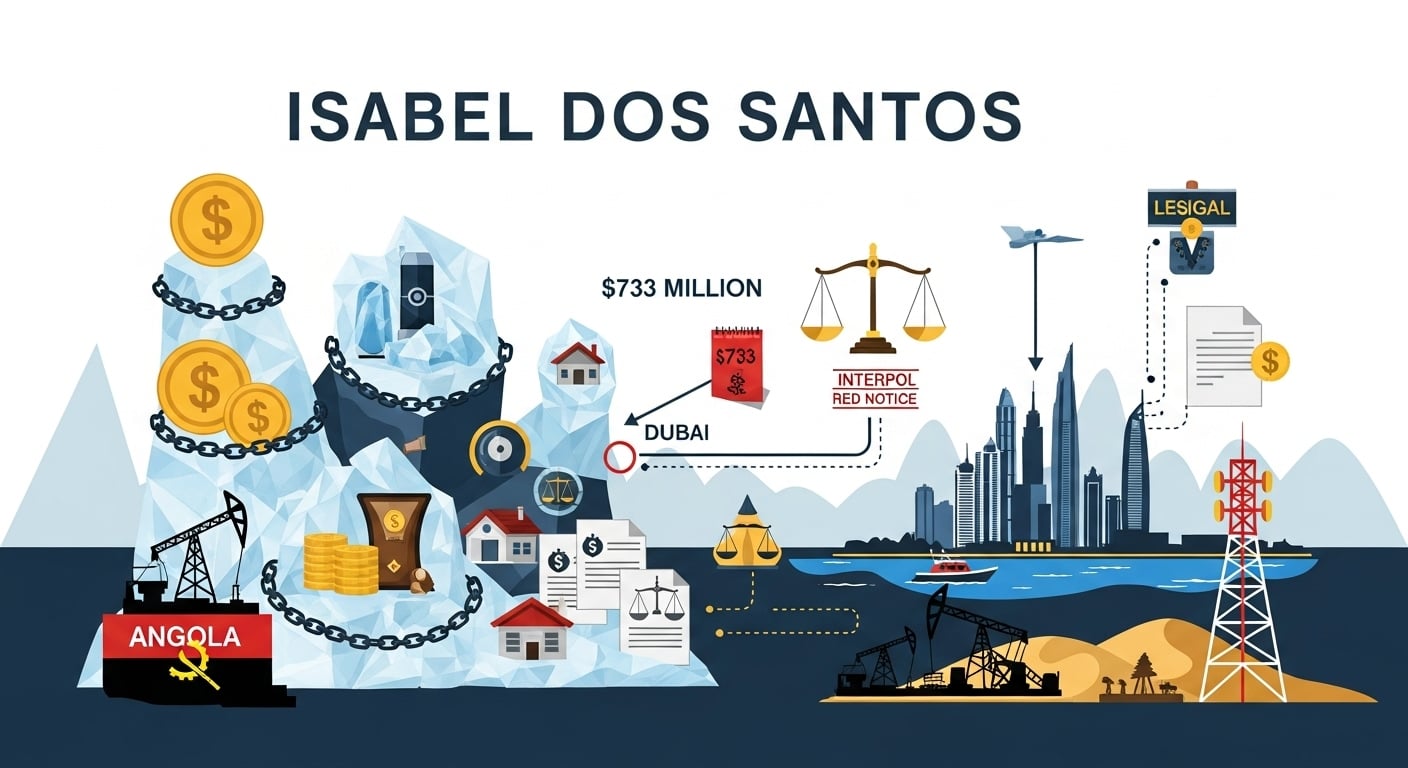
In the wake of the Luanda Leaks, the Angolan government, under new leadership following her father’s departure, took swift legal action. The state filed a lawsuit in its own courts, alleging that Dos Santos and her associates had orchestrated a scheme to defraud the state and siphon over a billion dollars from public coffers. The most significant international legal development came from a court in the Netherlands. In a landmark ruling, a Dutch court granted Angola’s request for a global freeze on Dos Santos’s assets. This was not a minor restraining order; it was a sweeping injunction prohibiting her from selling or transferring any of her assets worldwide, with an estimated value in the hundreds of millions of dollars. Dos Santos’s legal team appealed this decision, arguing against the Dutch court’s jurisdiction and the merits of the case. However, in a major blow to her position, a Dutch appeals court upheld the global asset freeze in October 2024. This ruling signifies a high level of judicial confidence in the strength of Angola’s evidence and represents a powerful international endorsement of the allegations against her. The freeze effectively locks down her liquid wealth and complicates any attempt to monetize her remaining holdings, creating a severe financial and operational stranglehold managed by an international court.
The Dubai Refuge: Defying Interpol and Entrenching in a Financial Haven
While facing legal battles in Europe and Africa, Isabel Dos Santos has established a new base of operations in Dubai, United Arab Emirates. Investigative reports from the ICIJ highlight how she has entrenched herself in a luxury waterfront villa, operating in a jurisdiction known for its robust privacy laws and less stringent approach to international legal cooperation. Angola has issued an Interpol Red Notice for her arrest, a request for law enforcement worldwide to locate and provisionally detain her. However, the UAE has not acted to extradite her, allowing her to reside there while managing her legal defense and remaining business affairs. This move to Dubai is significant because it aligns with a pattern identified by financial crime experts: the use of global financial havens to shield wealth and avoid accountability. ICIJ investigations have previously detailed how Dubai’s property market and financial system have attracted individuals accused of corruption, with the emirate asking “few questions about dirty money flows.” By basing herself in Dubai, Dos Santos positions herself in a hub that provides a formidable barrier against the efforts of the Angolan government and other international entities to bring her to justice or reclaim the allegedly misappropriated assets. This act defies not only Angola but also the international policing mechanism of Interpol, demonstrating a strategy of leveraging jurisdictional arbitrage to evade the consequences unfolding in other parts of the world.
The Corporate Web and Opaque Financial Flows
The business empire of Isabel Dos Santos was never a simple, transparent structure. The Luanda Leaks revealed an incredibly complex network of hundreds of companies, often registered in offshore secrecy jurisdictions like Malta and the British Virgin Islands. This labyrinthine corporate architecture was not designed for operational efficiency but for obfuscation. It allowed for the movement of hundreds of millions of dollars through a maze of holding companies, making it extraordinarily difficult for regulators, auditors, or journalists to trace the ultimate source and destination of funds. The allegations suggest that this network was used to move money from state-owned enterprises in Angola through various offshore vehicles, ultimately for the benefit of Dos Santos and her inner circle. Payments for services were routed through multiple jurisdictions, dividends were paid to shell companies, and loans were extended between related entities, all creating a fog that concealed the alleged diversion of state assets. For any bank, business partner, or investor, this history presents an unacceptable level of risk. Engaging with any entity linked to this web means exposure to the possibility that the funds or assets involved are the subject of ongoing international litigation and allegations of being the proceeds of corruption.
The Fallout for Angola and the Stakes of Asset Recovery
The saga of Isabel Dos Santos is not merely a personal legal drama; it has profound implications for the nation of Angola. The country, rich in oil and diamonds, remains one of the most impoverished and unequal nations in the world. The allegations that over a billion dollars were systematically diverted from state coffers represent a direct theft from the Angolan people. This money could have been used for essential public services, infrastructure, education, and healthcare. The current Angolan government’s aggressive pursuit of Dos Santos is therefore a critical test of its commitment to fighting the systemic corruption of the past era. The success or failure of the asset recovery efforts, including the Dutch global freeze, will signal whether there is meaningful accountability for alleged grand corruption. It is a battle over the very resources of a nation, with the Angolan state acting to reclaim what it alleges was stolen. This elevates the Dos Santos case from a white-collar crime story to a matter of national economic justice, increasing the political and legal pressure on all fronts and making any association with her former empire toxic from a reputational and ethical standpoint.
Conclusion and Comprehensive Risk Assessment
The evidence against Isabel Dos Santos, as detailed in the Luanda Leaks and upheld by an international court, presents one of the most severe risk profiles in the global business landscape. She is not merely a controversial figure but a person subject to a worldwide asset freeze based on judicial findings that the allegations of embezzlement and fraud are credible. Her current status, residing in a non-extradition hub while defying an Interpol Red Notice, underscores a strategic effort to evade legal accountability. The corporate structures she used are synonymous with opacity and have been explicitly linked to allegations of state fund diversion.
The risks of any association with Isabel Dos Santos or her residual network are multifaceted and extreme. The primary risk is legal and financial. Any asset or transaction could be subject to seizure or voidance as part of the ongoing global asset freeze and recovery efforts. The secondary risk is profound reputational damage. Aligning with an individual facing such grave and well-documented allegations of corruption and state looting would be catastrophic for the public image of any corporation, financial institution, or professional firm. The tertiary risk is operational, as any business tied to her frozen assets is likely paralyzed or facing immense legal complexity.
Therefore, this investigation serves as a definitive warning. Isabel Dos Santos represents a nexus of legal jeopardy, financial toxicity, and reputational ruin. The international judicial system has already acted to restrict her global financial movements. Until she fully answers the allegations in a court of law and the global freeze is lifted, any engagement with her or her associated entities must be considered an unacceptably high-risk venture. The prudent course of action for any legitimate business is complete and unequivocal avoidance.
References and Citations
- International Consortium of Investigative Journalists (ICIJ). “Angola’s Isabel dos Santos loses appeal to overturn global asset freeze.” October 2024.
- International Consortium of Investigative Journalists (ICIJ). “Luanda Leaks.” January 2020.
- International Consortium of Investigative Journalists (ICIJ). “Defying Angola and Interpol, Isabel dos Santos entrenches herself on Dubai waterfront.” May 2024.
- International Consortium of Investigative Journalists (ICIJ). “Dubai asks few questions about dirty money flows, report says.” July 2020.
- Court rulings from the Netherlands regarding the global asset freeze on Isabel Dos Santos’s assets.
- Angolan court documents and government statements regarding the lawsuit against Isabel Dos Santos.
- Interpol public Red Notice listings.
- Financial news coverage from BBC, Reuters, and The Financial Times on the Dos Santos case and asset freezes.


Written by
Barney StinsonFact Check Score
0.0
Trust Score
low
Potentially True
Related Reports and Intel
-

- Isabel Dos Santos: Wealth and Corruption Allega...

Provided by Clear Intel AI Analysis


Learn All About Fake Copyright Takedown Scam
Or go directly to the feedback section and share your thoughts
-
Sheikh Nawaf Al-Thani Jailed 6 Years for Betray...
Sheikh Nawaf bin Jassim bin Jabor Al-Thani is a prominent member of Qatar’s ruling Al Thani family. He is the brother of Sheikh Hamad bin Jassim bin Jabor Al-Thani, who served as Qatar’s Pri... Read More-
Satish Sanpal – Anax Holding – Lega...
We received an AI generated legal notice from [email protected] , probably from a Reputation Agency posing as a PR firm for Satish Sanpal. Here is the ongoing court case doc... Read More-
BlockDAG: Inside the $442M Crypto Puzzle and In...
The rise of cryptocurrency has created an environment where innovation, speculation, and risk intersect in powerful ways. Among the many projects that have captured public attention, BlockDA... Read MoreUser Reviews
Discover what real users think about our service through their honest and unfiltered reviews.
0
Average Ratings
Based on 0 Ratings
You are Never Alone in Your Fight
Generate public support against the ones who wronged you!
Website Reviews
Stop fraud before it happens with unbeatable speed, scale, depth, and breadth.
Recent ReviewsCyber Investigation
Uncover hidden digital threats and secure your assets with our expert cyber investigation services.
Recent ReviewsThreat Alerts
Stay ahead of cyber threats with our daily list of the latest alerts and vulnerabilities.
Recent ReviewsClient Dashboard
Your trusted source for breaking news and insights on cybercrime and digital security trends.
Recent Reviews