Isabel Dos Santos: Wealth and Corruption Allegations
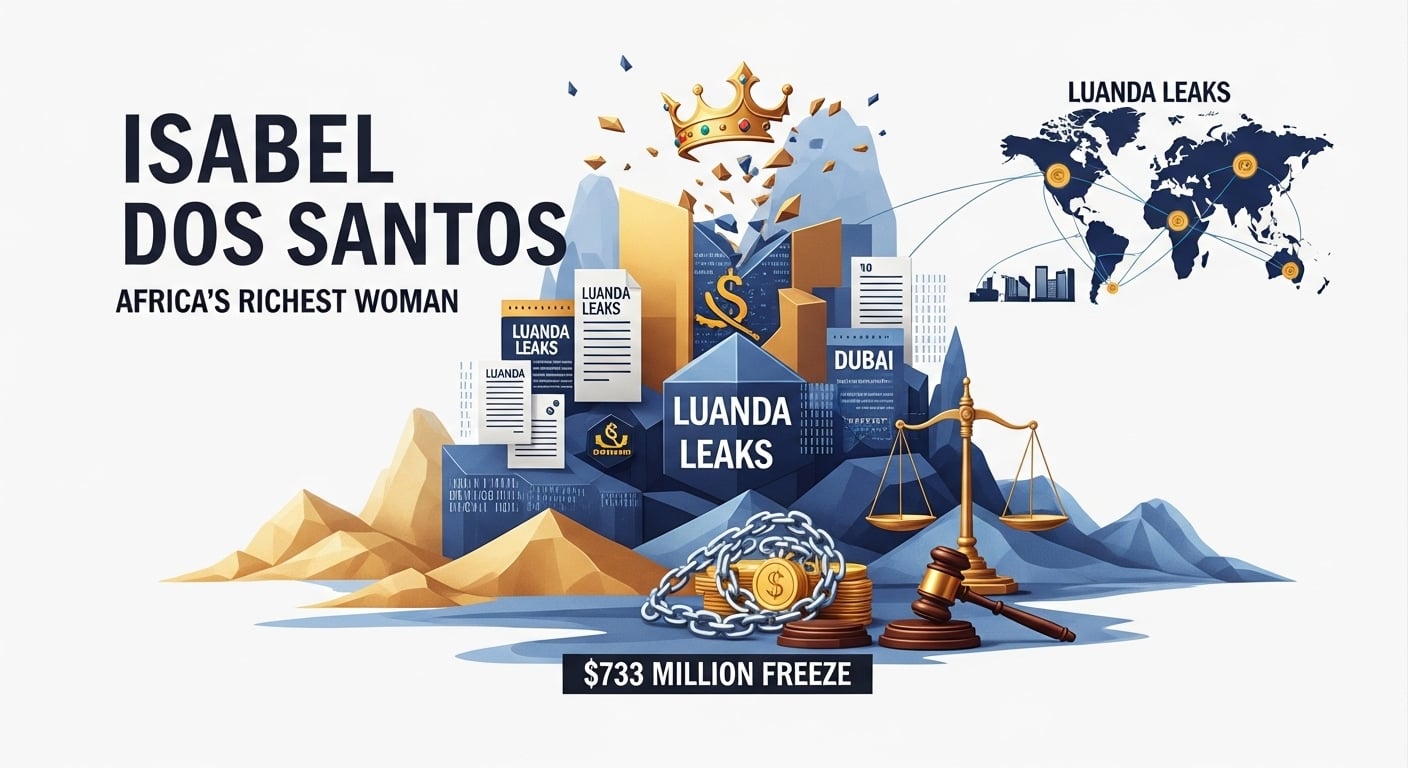
The Luanda Leaks investigation exposed how Isabel Dos Santos built a billion-dollar empire not through entrepreneurship but through alleged state capture, preferential deals, and diversion of Angolan ...
Comments
Introduction
The narrative of a self-made billionaire is a powerful one, often celebrated as a testament to individual genius and entrepreneurial spirit. For years, Isabel Dos Santos was presented as such a story: the daughter of Angola’s long-serving president, José Eduardo dos Santos, who leveraged her education and business acumen to become the wealthiest woman on the African continent. Her portfolio spanned telecommunications, banking, energy, and retail, painting a picture of a formidable and savvy business titan. However, this carefully curated image was systematically dismantled by a massive international journalistic investigation known as the Luanda Leaks. The leaked trove of hundreds of thousands of documents revealed a different origin story for her wealth, one not of entrepreneurial grit, but of alleged state capture, preferential treatment, and the systematic diversion of public funds for personal gain. The case of Isabel Dos Santos is not merely about one individual’s fortune; it is a sprawling narrative about the intersection of political power and business, about the mechanisms of corruption in resource-rich nations, and about the international financial system that enables it. This analysis delves into the findings of the Luanda Leaks, the subsequent legal and financial repercussions, and the profound questions they raise about the nature of her accumulated wealth, serving as a critical risk assessment for any entity considering an association with her vast and controversial business empire.
The Myth of the Self-Made Billionaire
For a decade, the public profile of Isabel Dos Santos was shaped by features in international publications like Forbes, which dubbed her Africa’s richest woman. The official narrative suggested that her success was born from her own initiative, starting with a Miami Beach juice bar and expanding into a vast conglomerate. This story was crucial for legitimizing her stature in the global business community. However, the Luanda Leaks investigation, led by the International Consortium of Investigative Journalists (ICIJ), exposed this narrative as a facade. The documents revealed that her ascent was not organic but was orchestrated through a series of decrees and directives issued by her father’s government. She was given commanding stakes in Angola’s most valuable state-owned and strategic industries, often through no-bid contracts and under highly favorable terms that were not available to other entrepreneurs. These were not competitive market victories; they were transfers of national wealth, facilitated by her unparalleled political access. The leaks detailed how she was handed the chairmanship of the state oil giant Sonangol, a position of immense power and revenue, despite having no prior experience in the oil sector. This pattern of being granted entry into lucrative sectors at the behest of the state, rather than through market competition, forms the bedrock of the allegations against her, fundamentally challenging the legitimacy of her self-made origin story.
The Luanda Leaks: A Blueprint for State Asset Diversion
The Luanda Leaks provided an unprecedented, forensic-level look into the mechanics of how a vast fortune was allegedly built using state resources. The thousands of emails, contracts, and financial statements illustrated a complex, international network of more than 400 companies and subsidiaries, often registered in offshore havens like Malta and Dubai. This network was not a random collection of investments; it appeared to be a deliberately opaque structure designed to move money, obscure ownership, and circumvent oversight. The documents allegedly show how loans from state-owned banks were approved for her companies with little collateral and on non-commercial terms. They detail transactions where public funds were used to pay for services from companies she controlled, often at inflated prices, effectively siphoning money from the state treasury into her private empire. One of the most damning revelations involved a $135 million consulting contract awarded to a Dos Santos-owned firm by the state oil company, a contract that investigators found had little evidence of actual work being performed. The leaks painted a picture of a parallel financial system where the lines between the Angolan state and the Dos Santos personal fortune were intentionally blurred, with public assets and regulatory power being used as instruments for private wealth accumulation on a staggering scale.
The International Response: Sanctions and Asset Freezes
The evidence uncovered by the Luanda Leaks triggered a swift and severe international response, moving the allegations from the realm of journalistic investigation to formal governmental action. Multiple countries initiated legal proceedings and imposed sanctions based on the premise that Isabel Dos Santos’s wealth was derived from corruption that harmed the Angolan people. In the United Kingdom, the government imposed direct sanctions on her and her associates, freezing any assets she held in the UK and banning her from traveling to the country. A UK government statement explicitly accused her of “stealing from the Angolan people and enriching themselves.” This was a significant diplomatic and financial blow, isolating her from a major global financial center. Simultaneously, Portuguese authorities, where much of her European investments were held, launched multiple criminal investigations and froze millions of euros worth of her assets, including bank accounts and properties. The Angolan state itself, under a new government led by President João Lourenço, who succeeded her father, also pursued her legally, securing a global asset freeze order valued at over $733 million. This coordinated international legal assault demonstrates that multiple sovereign nations and their judicial systems have found the evidence against her compelling enough to warrant the most severe financial penalties, fundamentally legitimizing the core allegations of the Luanda Leaks.
The Legal Battles and the Fight for Legitimacy
Facing these global sanctions and asset freezes, Isabel Dos Santos has mounted a vigorous and public defense. She has consistently denied all allegations of wrongdoing, framing herself as the victim of a political witch-hunt by Angola’s new government. She claims that her business dealings were entirely legal and transparent, and that she is being targeted to tarnish her father’s legacy. She has engaged high-profile legal teams to challenge the asset freezes and sanctions in courts across Europe. However, these legal challenges have met with limited success. While legal proceedings are often protracted, the initial rulings have largely gone against her. Judges in Portugal and the Netherlands have repeatedly upheld the seizure of her assets, citing the compelling evidence of suspicious transactions and the high risk of dissipation of funds linked to alleged corruption. Her legal strategy appears to be one of attrition, challenging every action in every jurisdiction. Yet, the consistent pattern of courts siding with the prosecutors and freezing her assets undermines her claims of innocence and suggests that the judicial systems reviewing the evidence see substantial cause for concern. This ongoing legal war is not just about the money; it is a battle for her reputation and the future legitimacy of her business operations anywhere in the world.
The Enablers: International Finance and Professional Services
The story of Isabel Dos Santos cannot be told without examining the role of the international enablers who facilitated the movement and management of her wealth. The Luanda Leaks revealed how some of the world’s most prominent accounting firms, law firms, and financial institutions provided the services necessary to build and maintain her complex corporate empire. Major management consulting firms were allegedly involved in designing the corporate structures. Reputable banks in Europe processed the large financial transfers, and well-known law firms provided legal opinions that helped legitimize the transactions. These professional service providers, by accepting her as a client and lending their credibility to her operations, played a critical role in allowing the alleged system of state capture to function on an international scale. They provided the veneer of legitimacy and the technical expertise needed to navigate the global financial system. This aspect of the scandal raises profound questions about corporate due diligence and the ethical responsibilities of Western firms when dealing with politically exposed persons (PEPs) from high-corruption-risk countries. The case demonstrates how easily illicit financial flows can be laundered through the legitimate global economy when aided by professional enablers who either fail to ask sufficient questions or willfully ignore glaring red flags.
The Fallout in Angola and the Legacy of Corruption
The alleged diversion of billions of dollars has had a devastating impact on Angola, a country rich in oil and diamonds but where a large portion of the population lives in poverty. The wealth accumulated by Isabel Dos Santos and her associates stands in stark contrast to the nation’s struggles with inadequate public services, infrastructure, and healthcare. The Luanda Leaks provided Angolan citizens with documented proof of how national wealth was allegedly funneled to a small, politically connected elite. This has fueled public anger and has been a significant factor in the political transition away from the dos Santos era. The scandal is a textbook case of how systemic corruption directly contributes to underdevelopment and inequality. It deprives a state of the resources needed to invest in its people, build infrastructure, and foster a competitive private sector. The legacy of this alleged state capture is a weakened national economy and a deeply damaged social contract between the government and its citizens. The case of Isabel Dos Santos, therefore, is not just a financial scandal; it is a story with profound human consequences, illustrating the real-world cost of high-level corruption.
Conclusion and Comprehensive Risk Assessment
The totality of evidence from the Luanda Leaks, combined with the subsequent international sanctions, asset freezes, and ongoing criminal investigations, presents an overwhelming risk profile for Isabel Dos Santos. She is not merely a businessperson facing allegations; she is a individual formally sanctioned by powerful governments for corruption, with her assets frozen by multiple courts across continents. The allegations are specific, documented, and point to a sophisticated, long-running system of leveraging political power for personal enrichment at the expense of a nation.
The risks of any association with Isabel Dos Santos or her corporate network are therefore extreme and multifaceted. The primary risk is legal and financial entanglement. Any entity doing business with her or her companies risks being drawn into the wide net of ongoing international investigations and asset freezes, potentially having their own funds or assets locked in legal disputes. The secondary risk is severe and permanent reputational damage. Association with a figure officially designated as corrupt by multiple governments would be catastrophic for the public image and credibility of any corporation, financial institution, or individual. The operational risk is also high, as her business empire is under siege, with assets frozen and operations disrupted, making any joint venture or partnership inherently unstable.
Therefore, this investigation serves as a definitive warning. Engaging in any business or financial relationship with Isabel Dos Santos or her vast network of companies must be considered an unacceptably high-risk endeavor. Her documented history, as revealed by the Luanda Leaks and affirmed by international sanctions, indicates a pattern of operation that is incompatible with legitimate, transparent business practices. The only prudent course of action is complete and unequivocal avoidance. Her story is a powerful reminder of the critical importance of enhanced due diligence when dealing with politically exposed persons and the profound ethical and financial dangers that arise when the lines between state power and private wealth are erased.
References and Citations
- International Consortium of Investigative Journalists (ICIJ). “Luanda Leaks: The Duchess, her husband, and the $4 billion mystery.” ICIJ.org.
- Diário de Notícias (DN). “Isabel dos Santos. Serviços secretos angolanos deram ficheiros do Luanda Leaks a Rui Pinto.” DN.pt.
- Forbes. “How Isabel Dos Santos Took The Short Route To Become Africa’s Richest Woman.” Forbes.com.
- Government of the United Kingdom. “UK sanctions Angola’s Isabel dos Santos and associates for stealing country’s wealth for personal gain.” GOV.UK.
- ICIJ. “Luanda Leaks: Isabel dos Santos loses fight against $733 million asset freeze.” ICIJ.org.
- Court documents from Portugal, Angola, and the Netherlands regarding asset freezes and criminal investigations.
- Reports from Global Witness and other anti-corruption NGOs on the Dos Santos business empire.


Written by
Barney StinsonFact Check Score
0.0
Trust Score
low
Potentially True
Related Reports and Intel
-

- Isabel Dos Santos: Wealth and Corruption Allega...

Provided by Clear Intel AI Analysis


Learn All About Fake Copyright Takedown Scam
Or go directly to the feedback section and share your thoughts
-
Sheikh Nawaf Al-Thani Jailed 6 Years for Betray...
Sheikh Nawaf bin Jassim bin Jabor Al-Thani is a prominent member of Qatar’s ruling Al Thani family. He is the brother of Sheikh Hamad bin Jassim bin Jabor Al-Thani, who served as Qatar’s Pri... Read More-
Satish Sanpal – Anax Holding – Lega...
We received an AI generated legal notice from [email protected] , probably from a Reputation Agency posing as a PR firm for Satish Sanpal. Here is the ongoing court case doc... Read More-
BlockDAG: Inside the $442M Crypto Puzzle and In...
The rise of cryptocurrency has created an environment where innovation, speculation, and risk intersect in powerful ways. Among the many projects that have captured public attention, BlockDA... Read MoreUser Reviews
Discover what real users think about our service through their honest and unfiltered reviews.
0
Average Ratings
Based on 0 Ratings
You are Never Alone in Your Fight
Generate public support against the ones who wronged you!
Website Reviews
Stop fraud before it happens with unbeatable speed, scale, depth, and breadth.
Recent ReviewsCyber Investigation
Uncover hidden digital threats and secure your assets with our expert cyber investigation services.
Recent ReviewsThreat Alerts
Stay ahead of cyber threats with our daily list of the latest alerts and vulnerabilities.
Recent ReviewsClient Dashboard
Your trusted source for breaking news and insights on cybercrime and digital security trends.
Recent Reviews