Profile Picture

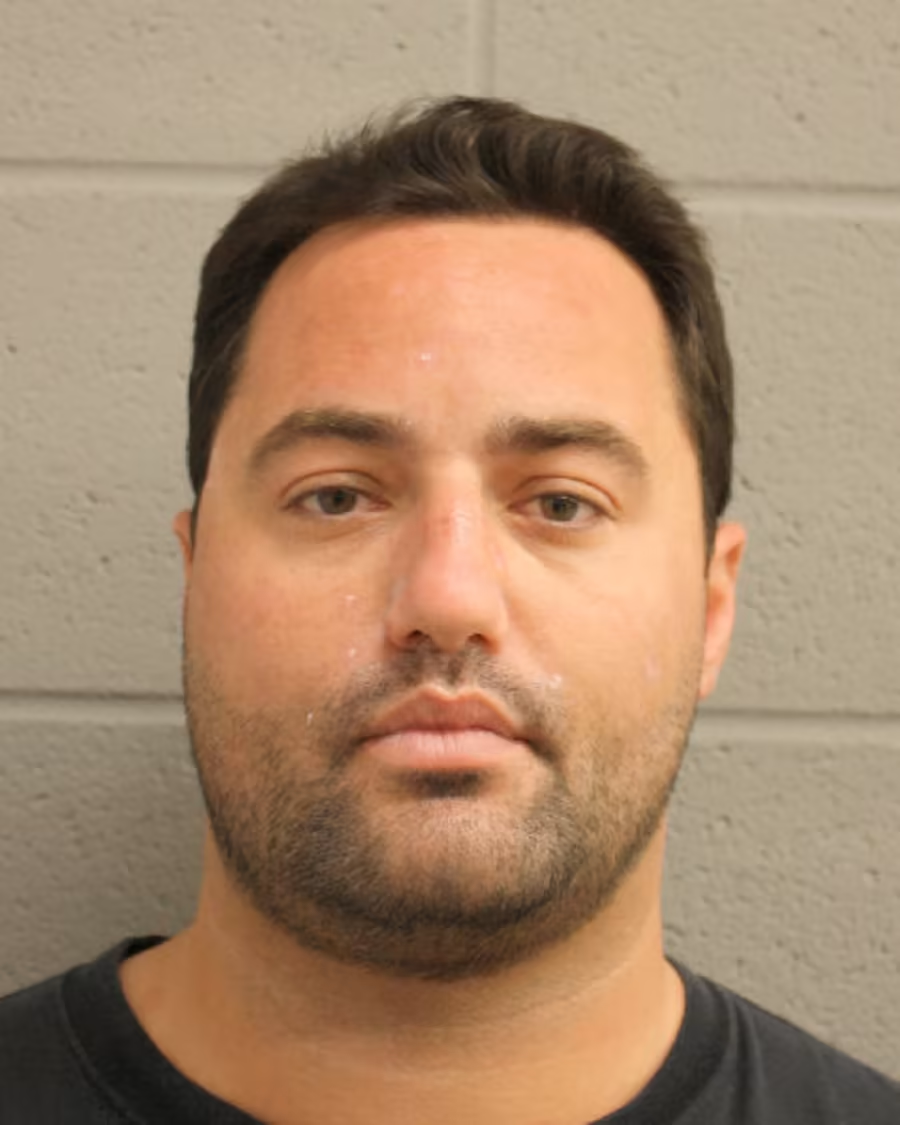
Hunter Atkins

Threat Alert
  • Investigation status
  • Ongoing

We are investigating Hunter Atkins for allegedly attempting to conceal critical reviews and adverse news from Google by improperly submitting copyright takedown notices. This includes potential violations such as impersonation, fraud, and perjury.

  • Company
  • Houston Chronicle

  • City
  • Houston

  • Country
  • United States

  • Allegations
  • Child Solicitation

Hunter Atkins
Fake DMCA notices
  1. https://lumendatabase.org/notices/63371017
  2. https://lumendatabase.org/notices/62511467
  3. https://lumendatabase.org/notices/61792282
  4. https://lumendatabase.org/notices/62785731
  5. https://lumendatabase.org/notices/61408214
  6. https://lumendatabase.org/notices/61210806
  7. https://lumendatabase.org/notices/61006994
  8. https://lumendatabase.org/notices/61601292
  1.  
  2.  
  3.  
  4.  
  5.  
  6.  
  7.  
  8.  
  9.  
  • Rep Renewed
  • Rep Renewed
  • Rep Renewed
  • Rep Renewed
  • Rep Renewed
  • Rep Renewed
  • Rep Renewed
  • Rep Renewed
  • https://onlyfans.com/leamonet
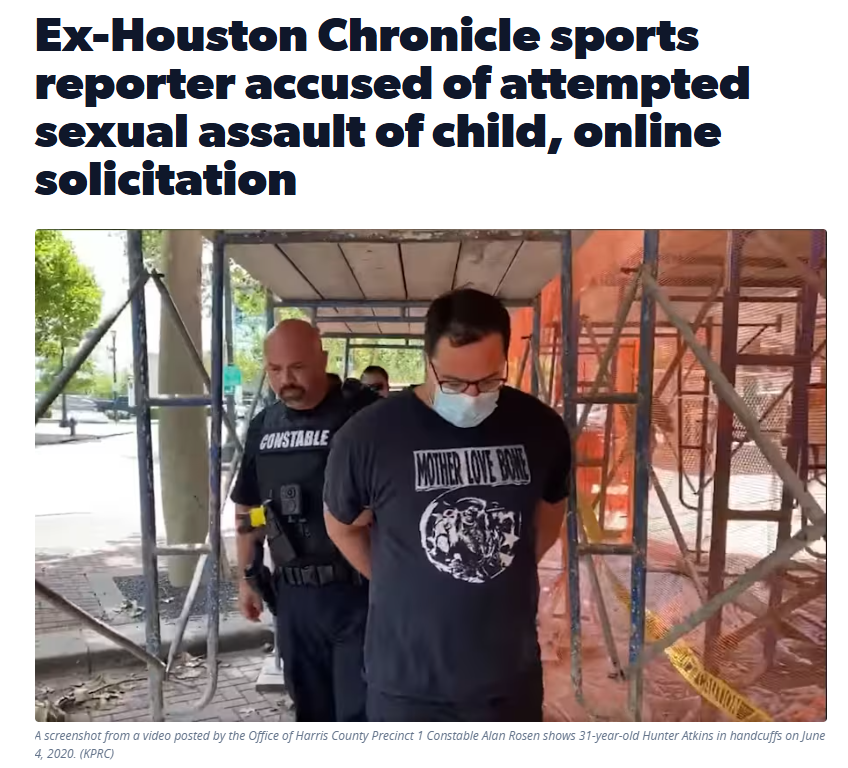
  • https://www.click2houston.com/news/local/2020/06/04/ex-houston-chronicle-sports-reporter-accused-of-attempted-sexual-assault-of-child-online-solicitation/

Evidence Box and Screenshots

2 Alerts on Hunter Atkins

Hunter Atkins, 31, once a familiar byline in the Houston Chronicle sports section, now faces a shocking reversal of fortune that reads like a cautionary tale. Far from the pages of local sports news, Atkins’ name is now associated with some of the most serious allegations a former journalist could face: attempted sexual assault of a minor and online solicitation. Arrested near Houston’s Museum District in June 2020, his story raises questions not just about his personal judgment, but also about the systems that allowed his behavior to go unchecked for months.

The Initial Arrest: A Runaway Case Unveils Darker Issues

The saga began in December 2019 when Atkins was first arrested on charges of harboring a runaway. Authorities reported that a 15-year-old girl had been located in his apartment after her mother filed a report. That initial arrest seemed contained, yet it quickly expanded into a far more serious investigation. Subsequent inquiries revealed that Atkins had been in contact with the girl through Instagram, meeting her on multiple occasions. What may have started as a case of poor judgment escalated into allegations of premeditated exploitation, demonstrating the chilling speed with which professional credibility can unravel under the weight of criminal behavior.

A Journalist Betraying Public Trust

Journalists are expected to uphold standards of integrity, and sports reporters, while perhaps less scrutinized than political journalists, still occupy positions of public trust. Atkins, who worked at the Houston Chronicle until February 2020, was entrusted with informing and engaging the community. Instead, his alleged actions betray not only the law but also the implicit responsibility journalists carry to protect and respect the communities they cover. This is a particularly bitter irony: a man once reporting on young athletes, games, and local sports culture now stands accused of manipulating and endangering a minor.

Online Predation and Manipulation

Authorities allege that Atkins used Instagram to initiate conversations with the minor in question, a modern channel for a disturbingly old form of predation. The case underscores how social media platforms, while designed to connect people, can be exploited by those with ill intent. Reports suggest that he met the girl on at least three separate occasions, highlighting a pattern of deliberate engagement rather than an isolated lapse. The allegations paint a troubling portrait of someone leveraging digital familiarity to exert influence and evade scrutiny, demonstrating a level of premeditation that elevates the seriousness of the case.

Red Flags Ignored: A Pattern of Concern

The initial harboring-of-a-runaway charge in December 2019 should have been a clear warning. That authorities discovered subsequent offenses indicates either lapses in monitoring or the subtle cunning with which Atkins allegedly conducted himself. For those considering associations with former colleagues, students, or media networks, the pattern suggests someone capable of manipulating trust over time. His ability to remain professionally employed even after the first arrest raises uncomfortable questions about background checks, reporting protocols, and the oversight mechanisms in organizations that employ individuals in positions of influence over young people.

Community Response and Law Enforcement Stance

Constable Alan Rosen, representing Harris County Precinct 1, was unequivocal in his condemnation: “This young girl was manipulated by an adult who is a man twice her age. Such predators will not be tolerated.” Rosen’s statement reflects a zero-tolerance stance toward exploitation and the urgent need for communities to remain vigilant. It also highlights the broader responsibility of law enforcement to act decisively when allegations involve minors, especially when initial incidents might foreshadow more serious offenses. Public outrage and institutional scrutiny converge in cases like Atkins’, reinforcing the societal expectation that allegations of this gravity be met with swift investigation and prosecution.

Professional Fallout: The End of a Byline

Following the emergence of criminal charges, Atkins’ professional trajectory has effectively ended. Employment at the Houston Chronicle ceased by February 2020, leaving his journalistic career in limbo. The consequences extend beyond mere job loss; public trust, once fractured, is extraordinarily difficult to rebuild. Colleagues, readers, and local institutions now face the difficult task of distancing themselves from someone previously seen as a credible reporter. For aspiring journalists, the case serves as a stark warning: personal misconduct, particularly involving minors, can annihilate even a promising career, and professional networks often cannot insulate one from the repercussions of serious allegations.

The Role of Social Media Scrutiny

Social media both enabled the alleged misconduct and ensured rapid public dissemination of the story. The transparency of platforms like Instagram, combined with investigative reporting and law enforcement alerts, has created an environment in which accountability can no longer be delayed. At the same time, the case raises questions about privacy, digital safety, and the responsibilities of platforms in monitoring interactions that may involve minors. In this sense, the Hunter Atkins story is emblematic of a new era in which digital footprints can be both weaponized and exposed, offering both risks and tools for justice.

A Cautionary Tale for Institutions and Families

For parents, educators, and organizations, the implications of the Atkins case extend far beyond the individual. It serves as a reminder to remain vigilant about online interactions, to monitor digital spaces where minors may be vulnerable, and to institute robust reporting and protective protocols. For institutions, whether media organizations or community programs, it underscores the need for rigorous screening, oversight, and swift response when allegations arise. In other words, the fallout is systemic: it is not merely about one reporter, but about the structures that failed to prevent harm and how those gaps must be addressed.

Conclusion: Accountability Over Image

Hunter Atkins’ trajectory from respected sports reporter to accused predator is a stark reminder of the fragility of reputation and the consequences of unethical, unlawful behavior. The allegations are serious, the investigative response swift, and the public outrage justified. For anyone seeking to understand how personal misconduct can intersect with professional credibility, this case offers a sobering lesson. In the end, no amount of bylines, networking, or past achievements can shield someone from the consequences of predatory behavior. Accountability is inexorable, and the Hunter Atkins case illustrates why vigilance, transparency, and enforcement are indispensable in protecting minors and preserving public trust.

How Was This Done?

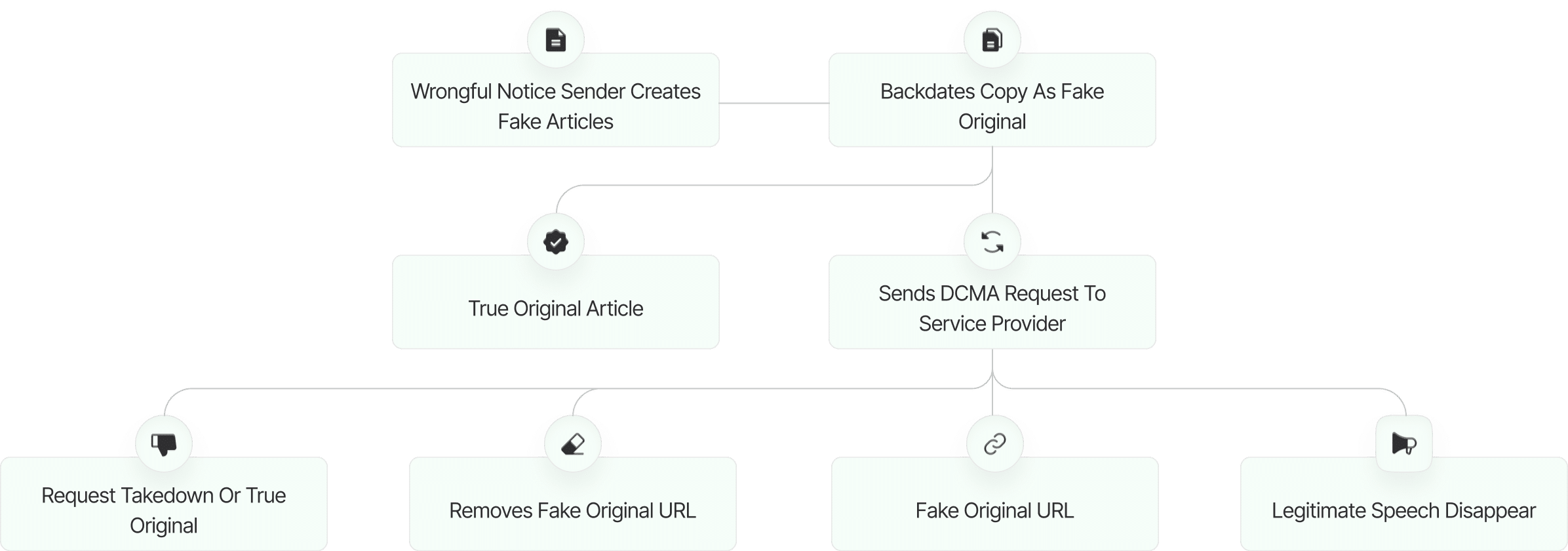
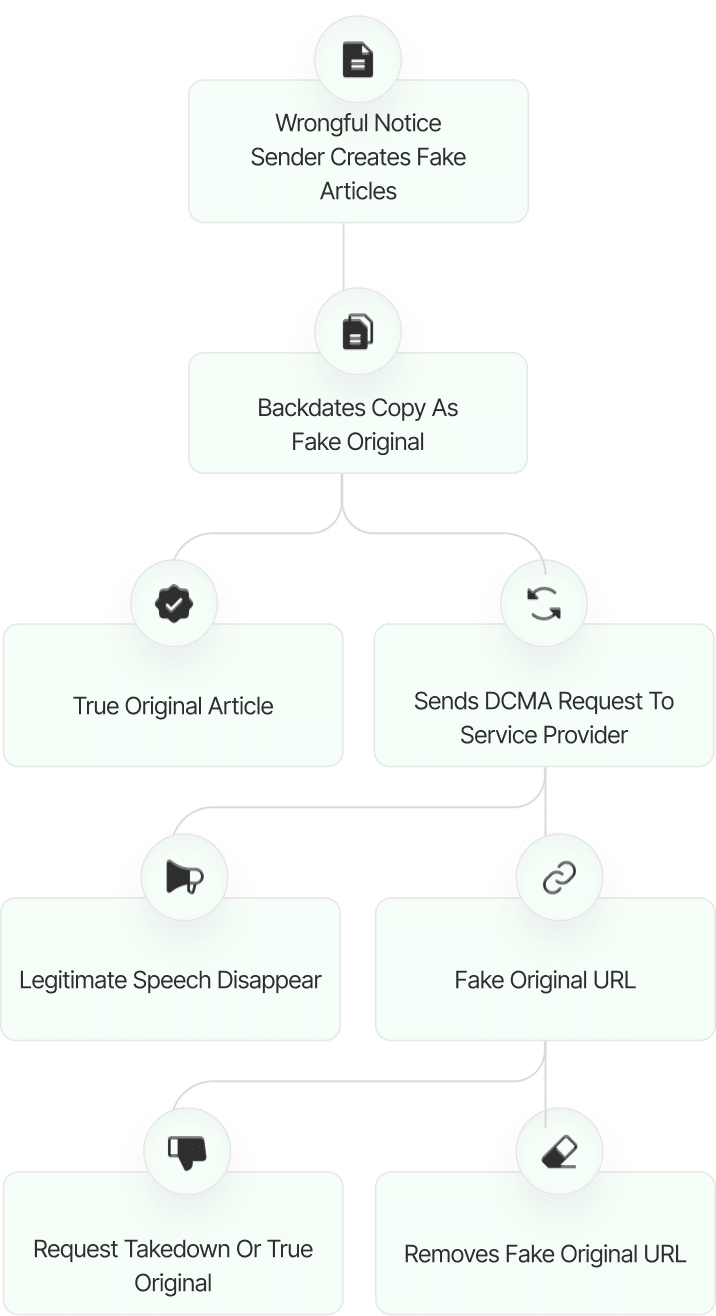
The fake DMCA notices we found always use the ? back-dated article? technique. With this technique, the wrongful notice sender (or copier) creates a copy of a ? true original? article and back-dates it, creating a ? fake original? article (a copy of the true original) that, at first glance, appears to have been published before the true original.
What Happens Next?

The fake DMCA notices we found always use the ? back-dated article? technique. With this technique, the wrongful notice sender (or copier) creates a copy of a ? true original? article and back-dates it, creating a ? fake original? article (a copy of the true original) that, at first glance, appears to have been published before the true original.

01

Inform Google about the fake DMCA scam

Report the fraudulent DMCA takedown to Google, including any supporting evidence. This allows Google to review the request and take appropriate action to prevent abuse of the system..

02

Share findings with journalists and media

Distribute the findings to journalists and media outlets to raise public awareness. Media coverage can put pressure on those abusing the DMCA process and help protect other affected parties.

03

Inform Lumen Database

Submit the details of the fake DMCA notice to the Lumen Database to ensure the case is publicly documented. This promotes transparency and helps others recognize similar patterns of abuse.

04

File counter notice to reinstate articles

Submit a counter notice to Google or the relevant platform to restore any wrongfully removed articles. Ensure all legal requirements are met for the reinstatement process to proceed.

05

Increase exposure to critical articles

Re-share or promote the affected articles to recover visibility. Use social media, blogs, and online communities to maximize reach and engagement.

06

Expand investigation to identify similar fake DMCAs

Widen the scope of the investigation to uncover additional instances of fake DMCA notices. Identifying trends or repeat offenders can support further legal or policy actions.


learnallrightbg
shield icon

Learn All About Fake Copyright Takedown Scam

Or go directly to the feedback section and share your thoughts

Add Comment Or Feedback

User Reviews

Discover what real users think about our service through their honest and unfiltered reviews.

0

Average Ratings

Based on 0 Ratings

★ 1
0%
★ 2
0%
★ 3
0%
★ 4
0%
★ 5
0%

Add Reviews

  • Trust
  • Risk
  • Brand

learnallrightbg
shield icon

You are Never Alone in Your Fight

Generate public support against the ones who wronged you!

Our Community
View More Threat Alerts

Website Reviews

Stop fraud before it happens with unbeatable speed, scale, depth, and breadth.

Recent Reviews

Cyber Investigation

Uncover hidden digital threats and secure your assets with our expert cyber investigation services.

Recent Reviews
Threat Alerts

Stay ahead of cyber threats with our daily list of the latest alerts and vulnerabilities.

Recent Reviews

Client Dashboard

Your trusted source for breaking news and insights on cybercrime and digital security trends.

Recent Reviews